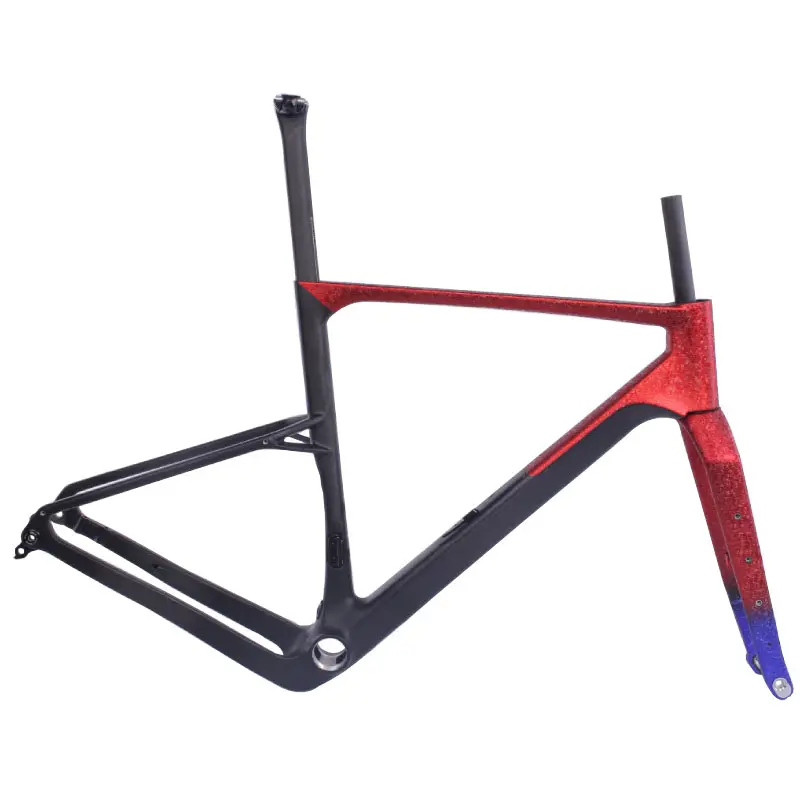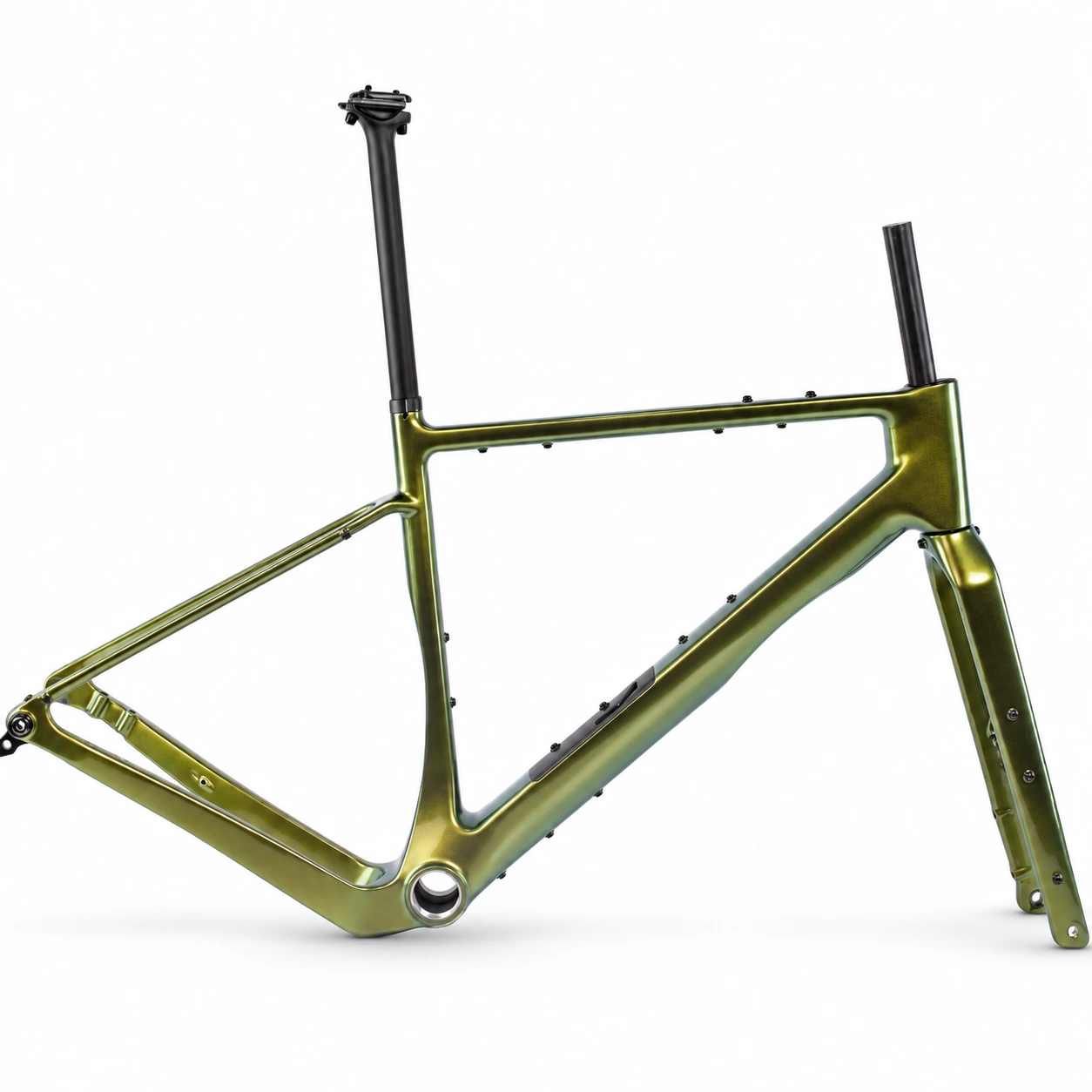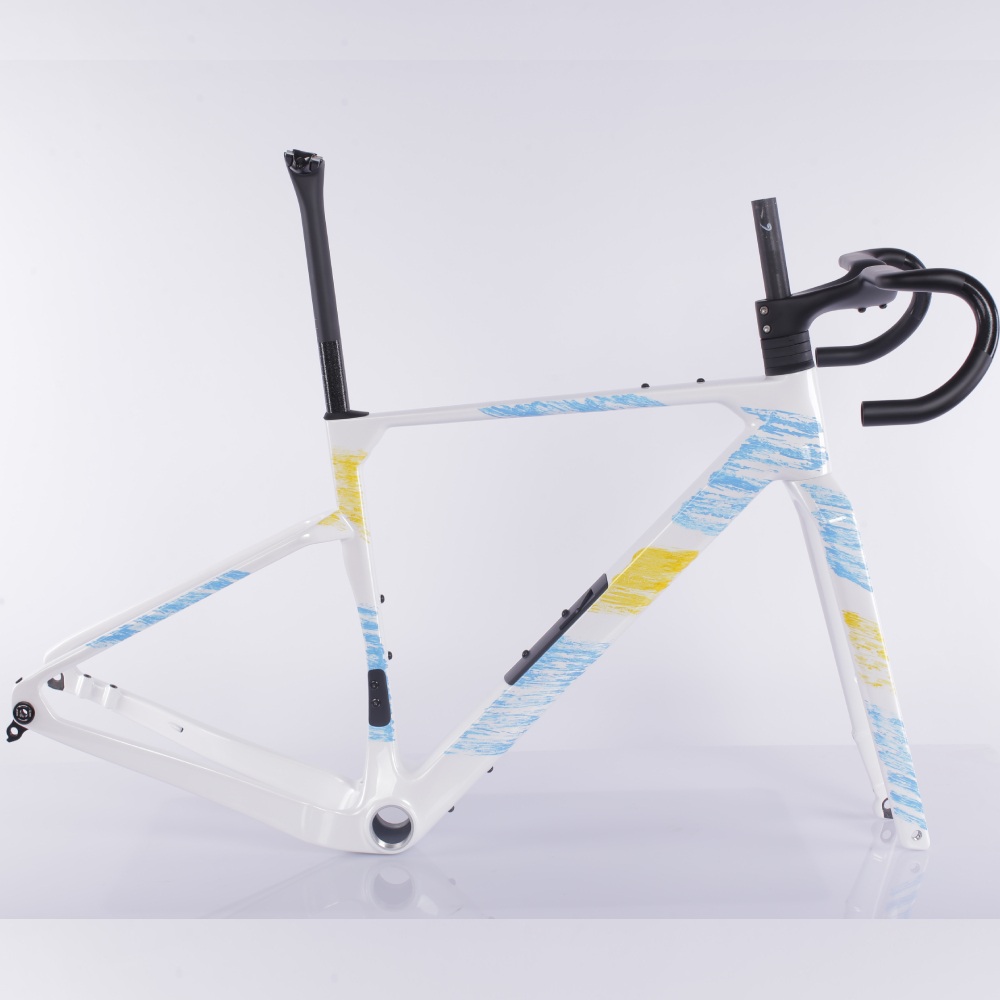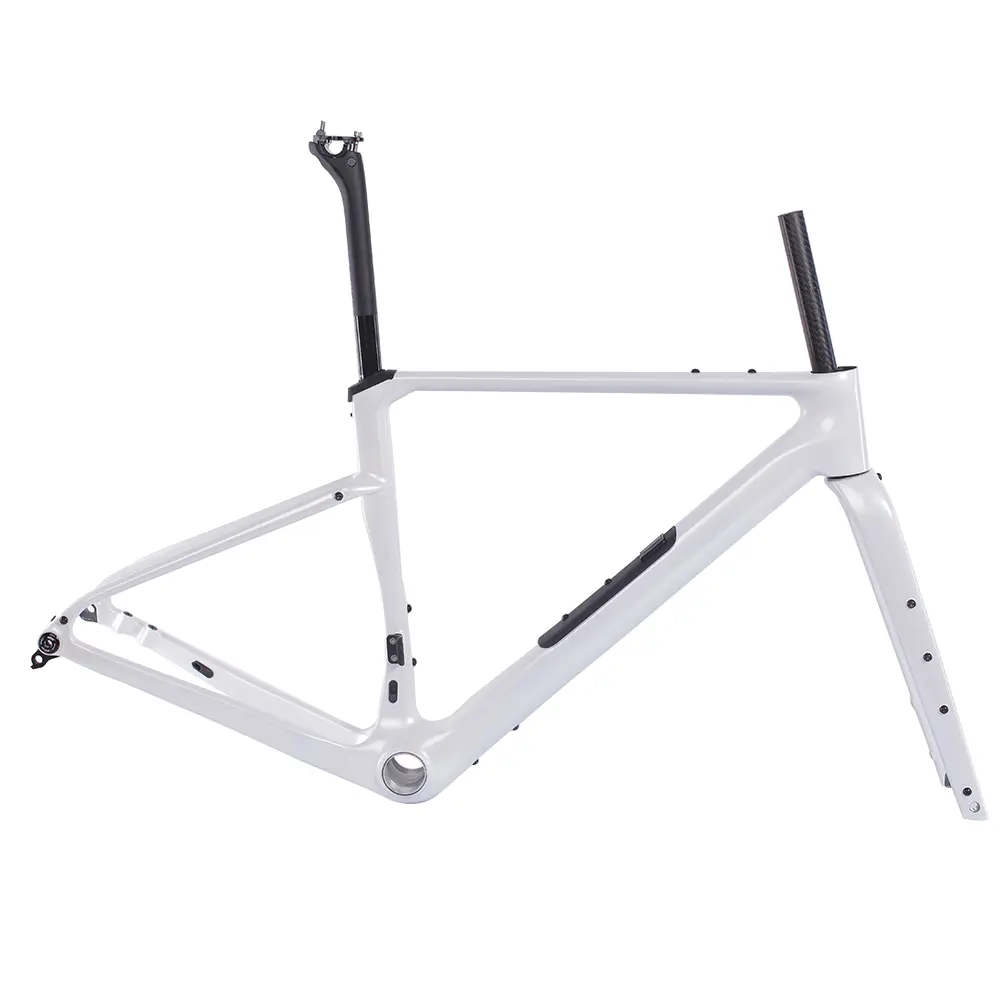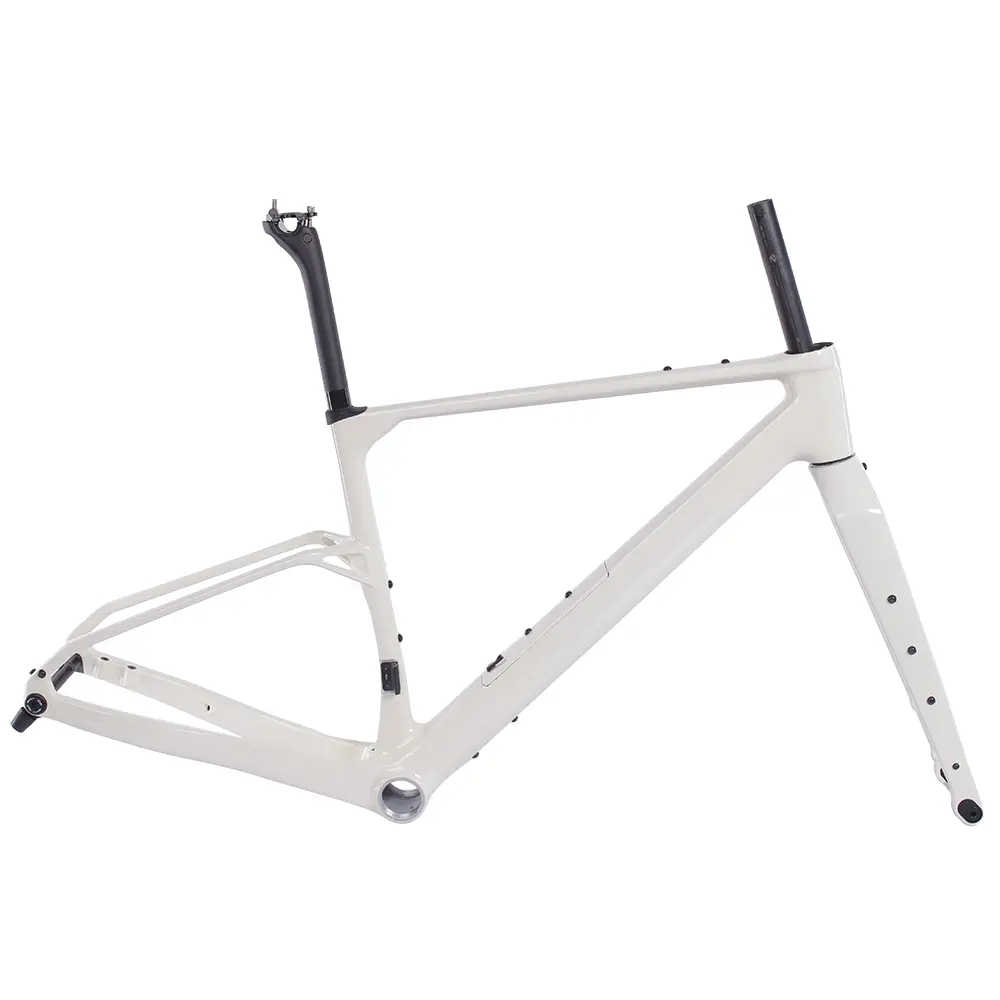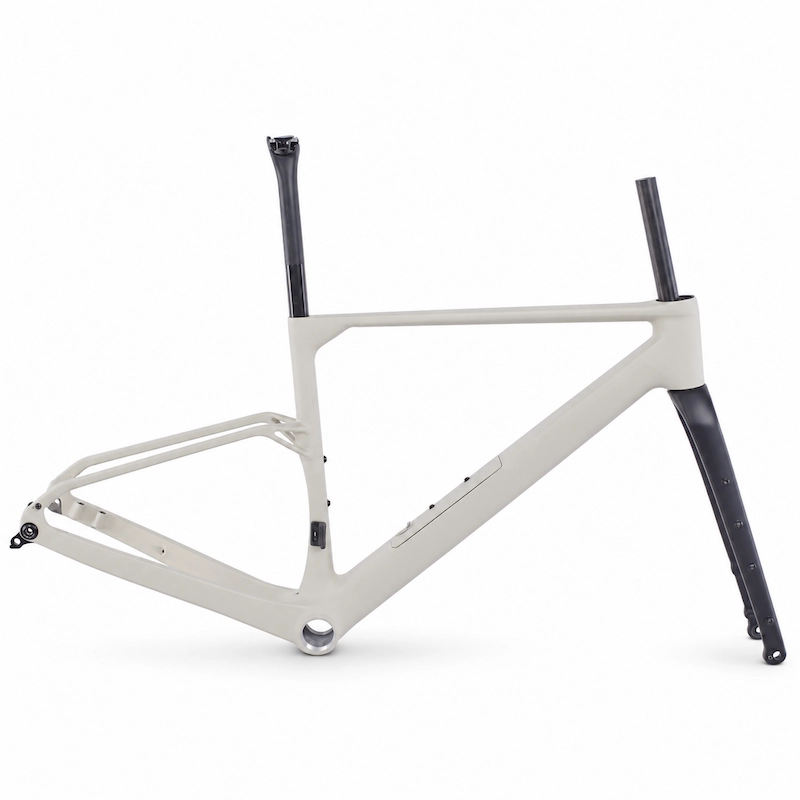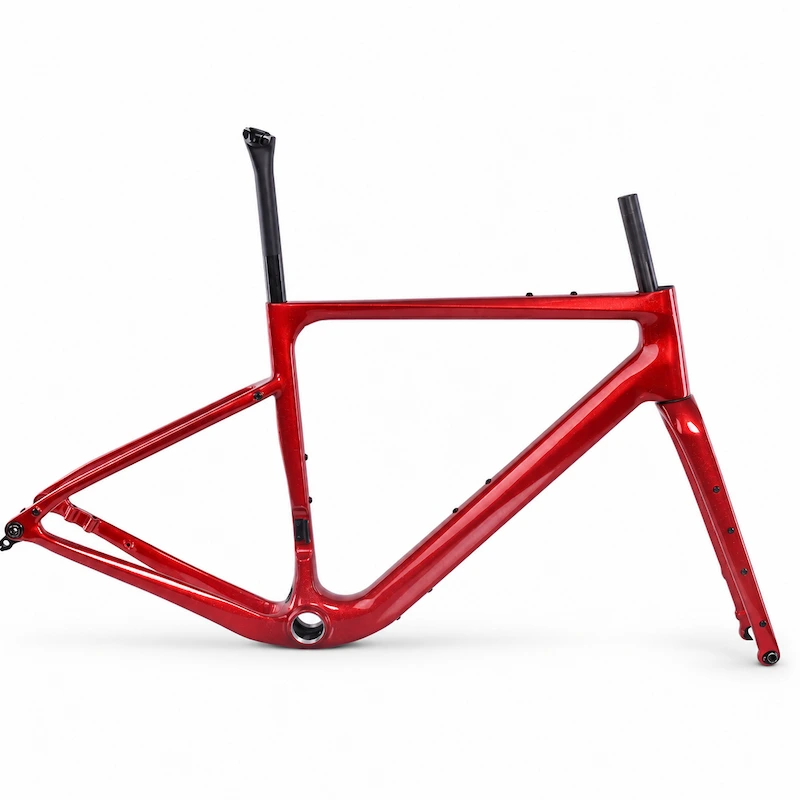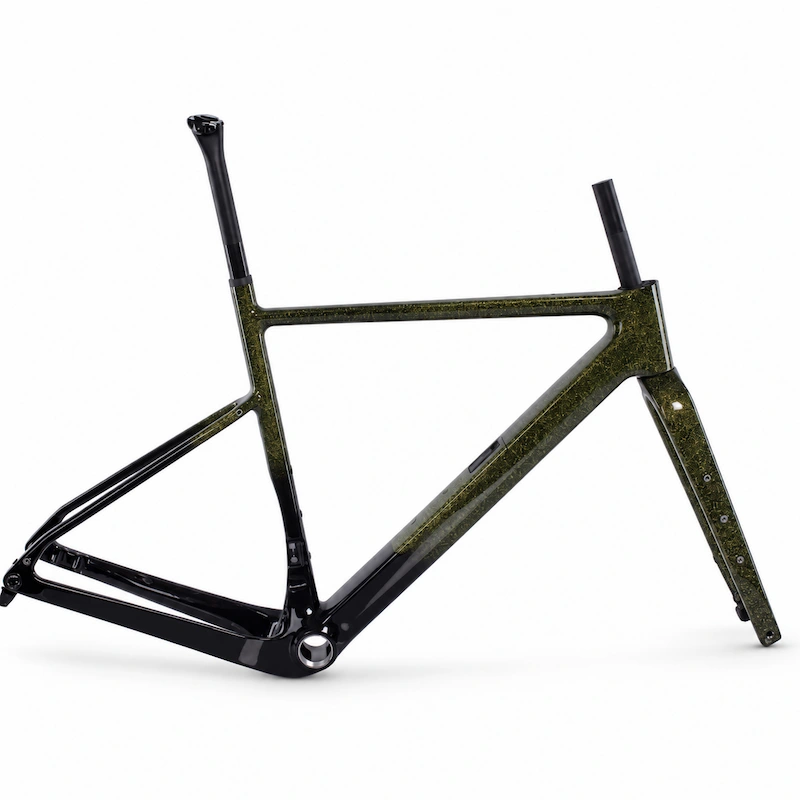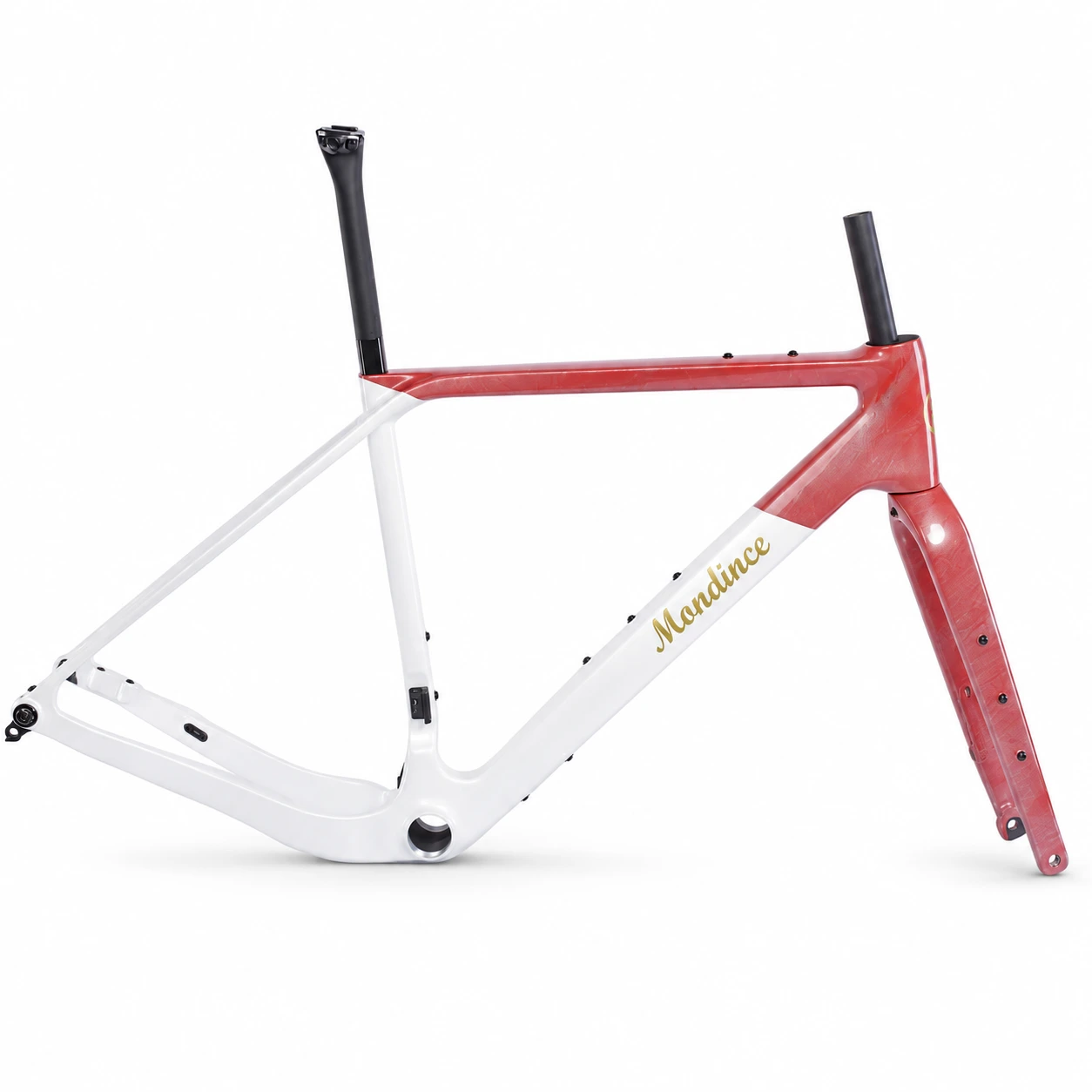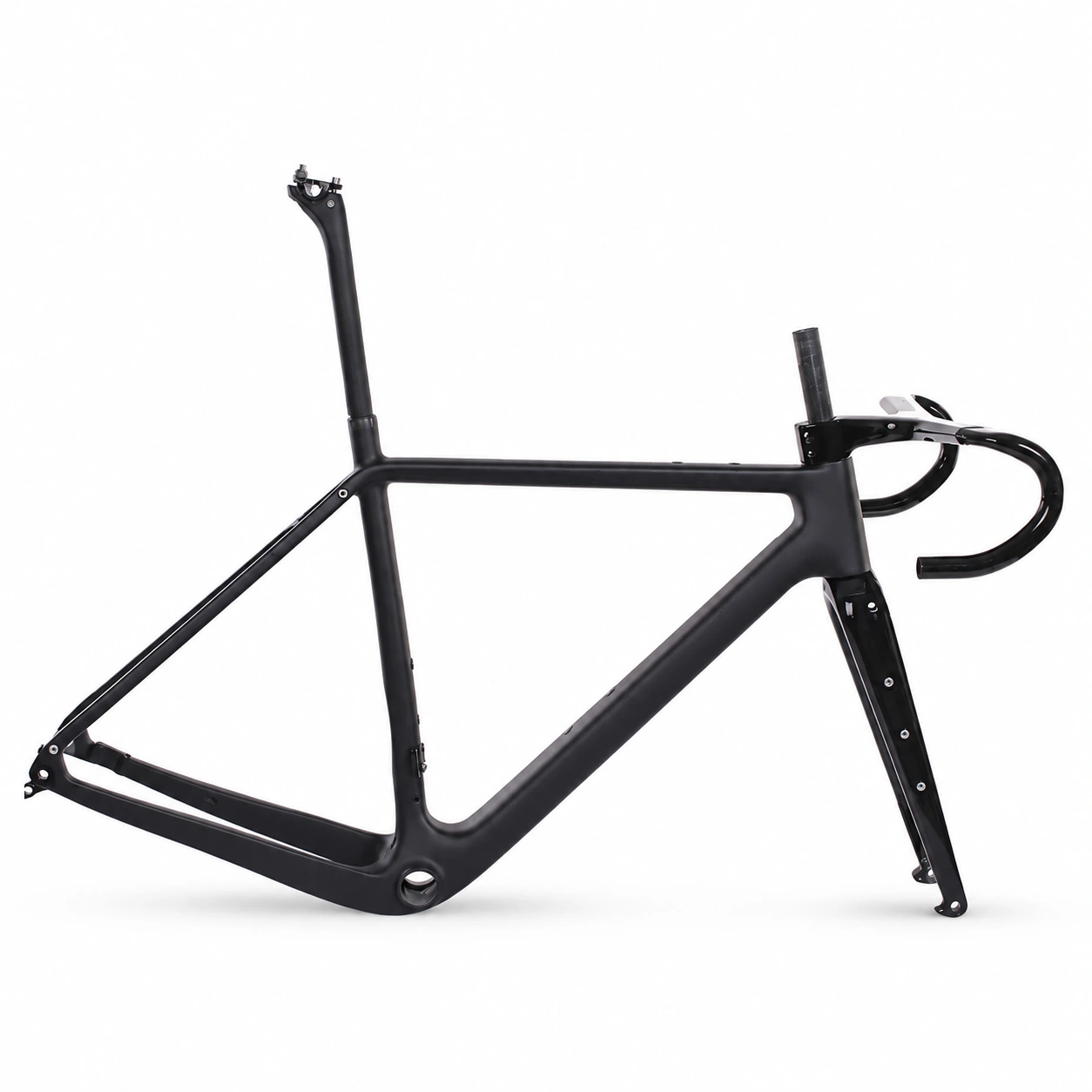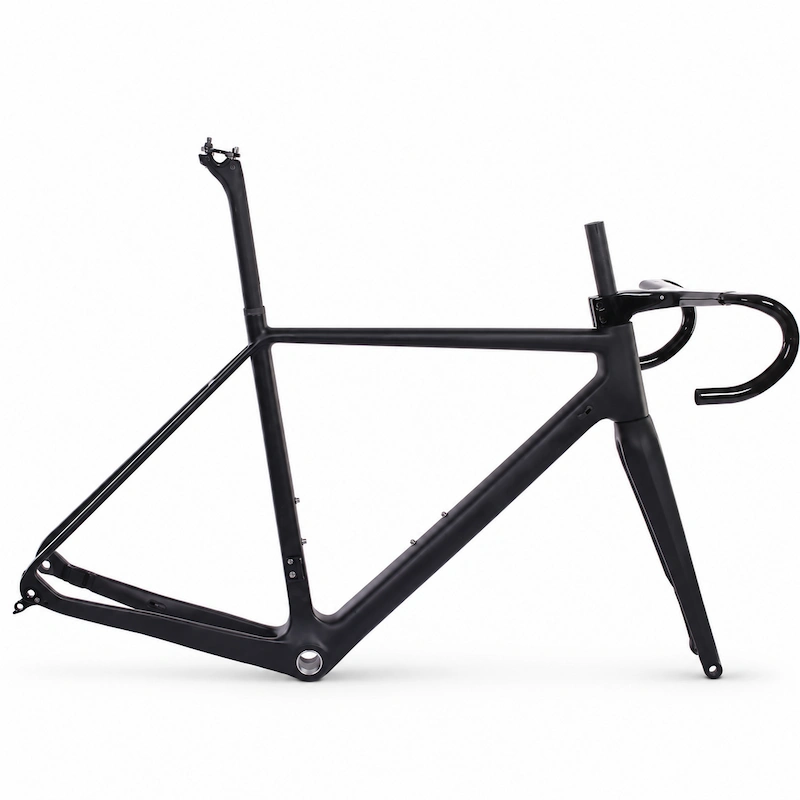
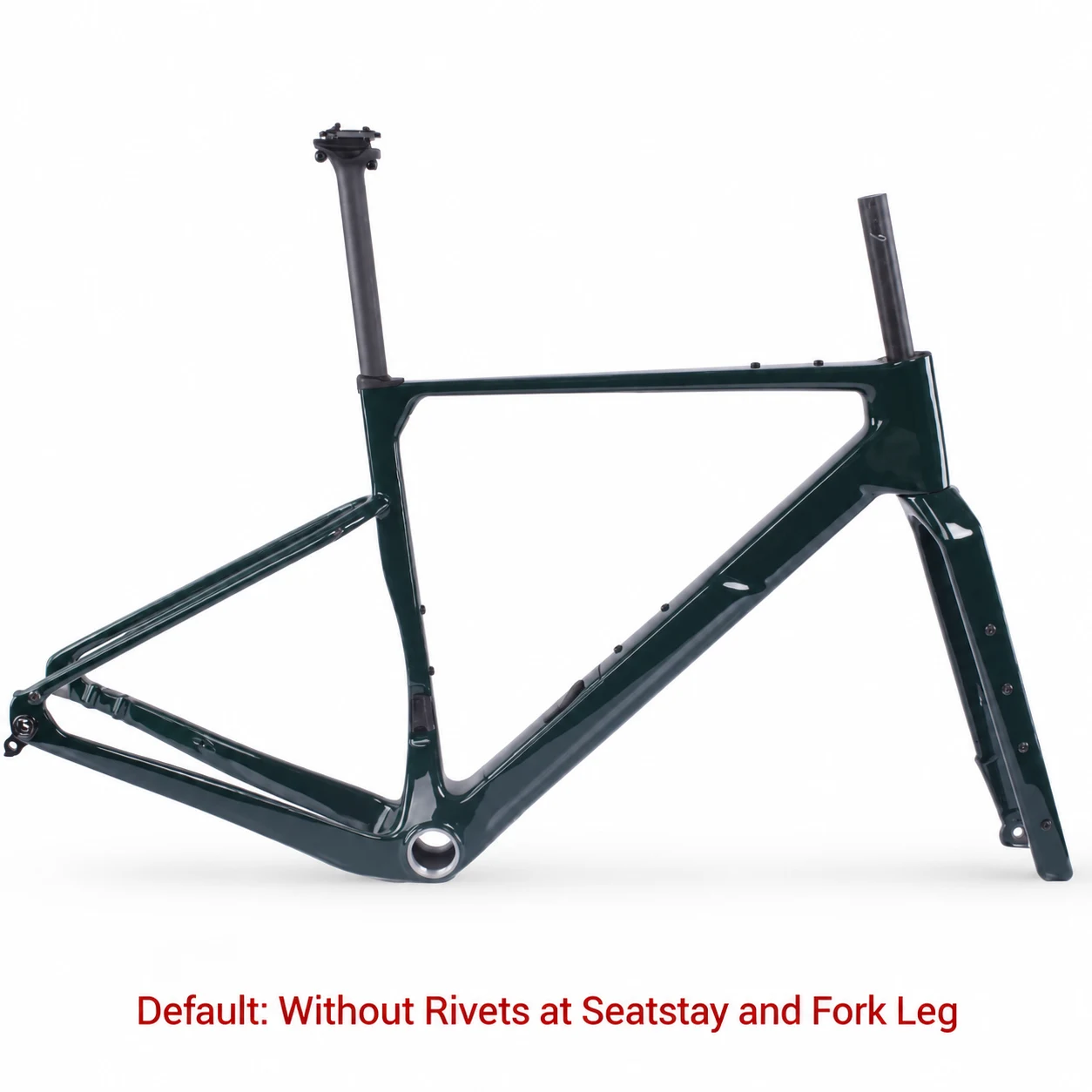
Mondince FM376 All-Terrain Racing Gravel Frameset
Standard frameset price$580 USD
57mm all terrain carbon gravel frame with integrated storage. UDH, T47 BB, EN-certified. Perfect for racing and fast gravel.
Performance Carbon Frames for Your Next Ride
Racing, all-road and bikepacking framesets
Compare 12 Toray carbon gravel framesets for racing, all-road, and bikepacking. Each carbon gravel bike frame lists weight, tire clearance (42-61 mm), geometry, T47/UDH options, and standard frameset price from $435-625. Use the table to shortlist a carbon gravel frame, then open the model page for size charts and included parts. Single frameset orders and custom paint are available.
Standard prices: $435–625 USD Each model page lists its exact price. Frame, fork, seatpost, FD cover, headset and bag are included; painting, shipping and taxes are excluded.
Compare complete framesets by riding style, weight and tire clearance. Open any model for its size-by-size geometry, compatibility details and included parts.
Filter the collection by tire clearance and frame weight. Clearance figures are measured with a 32 mm internal rim width.
Standard frameset price$580 USD
57mm all terrain carbon gravel frame with integrated storage. UDH, T47 BB, EN-certified. Perfect for racing and fast gravel.
Best Seller Standard frameset price$605 USD
57mm aero carbon gravel frame with integrated storage. UDH, T47 BB, EN-certified. Perfect for racing and fast gravel.
Standard frameset price$625 USD
61mm max tire clearance carbon bikepacking gravel frame with UDH hanger & T47 BB, Toray T800+T1000 carbon, OEM custom paint available
Standard frameset price$580 USD
57mm tire carbon gravel frame with chainstay & downtube protector. T47 BB, UDH, internal storage. Built for all terrain racing.
Standard frameset price$525 USD
Ultra-light, high-stiffness gravel race frame. Features downtube storage, aero tubes, and T47 BB. Ideal for competitive racing and long-distance.
Standard frameset price$525 USD
Aero carbon gravel frame built for speed. Features T1000 carbon, T47 BB, and 50mm tire clearance. Versatile for racing and bikepacking.
Standard frameset price$525 USD
Balanced all-rounder with integrated downtube storage. Offers aero efficiency and 50mm tire clearance. Built for endurance and adventure.
Standard frameset price$495 USD
Adventure-ready frame with Flip Chip fork for adjustable handling (45/50mm rake). T47 BB and 50mm tire clearance for all-road comfort.
Standard frameset price$505 USD
Versatile and durable UDH gravel frame. Designed for mixed terrain with 50mm tire clearance, T47 BB, and mod cons. Ideal for bikepacking.
Standard frameset price$515 USD
Ultra-lightweight racing gravel frame. Starts at 950g and features T47 BB and 50mm tire clearance. Built for speed and climbing.
Standard frameset price$475 USD
Clean and customizable frameset. Features fully internal cable routing, UDH hanger, and BSA/BB86 bottom bracket options. A solid foundation for any build.
Standard frameset price$435 USD
Purpose-built for cyclocross racing and light gravel. Features a BSA bottom bracket, 42mm tire clearance, and classic geometry.
Start with the surfaces you ride and the parts you plan to use. Compare tire clearance first: a 42-45 mm platform suits a different build from one designed for 50, 57 or 61 mm tires. Then check stack, reach and your preferred riding position in the size-specific geometry chart. Confirm the bottom bracket, derailleur hanger and internal cable-routing requirements against your actual components. FM166 uses a standard hanger; FM266 offers configurable standards. For bikepacking, check luggage mounts and bag space rather than assuming every gravel frame accepts the same equipment.
FM286 (950 g, 50 mm), FM336 (1,050 g, 47 mm) and FM346 (1,150 g, 57 mm). Light, stiff race platforms with 425-435 mm chainstays for fast direction changes. FM286 is the lightest frame we make.
FM366 (1,050 g) and FM376 (1,080 g), both 57 mm clear. Aero seatstays, integrated downtube storage on FM366, and geometry built around holding speed on mixed surfaces.
FM356 is the 61 mm platform for mud, loose gravel and loaded bags; FM326 uses a flip-chip fork to run 650B x 2.1 in or 700C, with 50 mm tire clearance.
FM316 (85.5 mm BB drop, aero tube shapes) and FM306 (flip-chip offset, 68.9° head tube angle) trade a little sharpness for stability and long-distance comfort.
FM296 and FM336 carry integrated downtube storage for ride essentials. Compare the storage opening, frame size and listed weight before planning your kit. Both use UDH and T47 standards.
FM266 (BSA / BB86 or T47, 45 mm) is the value platform for first builds and shop stock. FM166 is our cyclocross frame: BSA threaded, 42 mm clearance, 425 mm chainstay, quick handling.
Use this comparison to shortlist a carbon gravel bike frame by riding style, weight, tire clearance and standards. Weights are size M, raw frames without hardware; tire clearance is measured with a 32 mm internal rim width.
| Model | Best for | Frame weight (M, raw) | Max tire clearance | Bottom bracket | Hanger | Carbon | Sizes | Standard price (USD) |
|---|---|---|---|---|---|---|---|---|
| FM366 Aero Gravel Frame | Aero gravel racing | 1050g | 57mm | T47 85.5 mm | UDH | Toray Grade T1000 | XS-XL | $605 |
| FM356 Bikepacking Frameset | Bikepacking, 61 mm | 1100g | 61mm | T47 85.5 mm | UDH | Toray Grade T800+T1000 | S-XL | $625 |
| FM376 All-Terrain Race Frame | All-terrain racing | 1080g | 57mm | T47 85.5 mm | UDH | Toray Grade T800+T1000 | S-XL | $580 |
| FM346 Wide-Tire Gravel Frame | Gravel racing, 57 mm | 1150g | 57mm | T47 85.5 mm | UDH | Toray Grade T800+T1000 | S-XL | $580 |
| FM336 Gravel Frame with Storage | Racing with downtube storage | 1050g | 47mm | T47 85.5 mm | UDH | Toray Grade T800+T1000 | XS-XL | $525 |
| FM326 Flip-Chip Frameset | Expedition, flip-chip fork | 1100g | 50mm | T47 85.5 mm | UDH | Toray Grade T800+T1000 | XS-XL | $525 |
| FM316 Aero Endurance Frame | Aero endurance | 1150g | 50mm | T47 85.5 mm | UDH | Toray Grade T800+T1000 | XS-XL | $525 |
| FM306 Comfort Gravel Frame | Comfort, flip-chip offset | 1010g | 50mm | T47 85.5 mm | UDH | Toray Grade T1000 | XS-XL | $495 |
| FM296 Storage Gravel Frame | Lightweight with storage | 1150g | 50mm | T47 85.5 mm | UDH | Toray Grade T1000 | XS-XL | $505 |
| FM286 Lightweight Race Frame | Climbing and racing | 950g | 50mm | T47 85.5 mm | UDH | Toray Grade T800+T1000 | XS-XL | $515 |
| FM266 All-Road Frameset | Entry level, value builds | 1150g | 45mm | BSA / BB86 or T47 | Standard or UDH | Toray Grade T800+T1000 | XS-XL | $475 |
| FM166 Cyclocross Frameset | Cyclocross | 1020g | 42mm | BSA | Standard | Toray Grade T800+T1000 | XS-XL | $435 |
Tire clearance values in the table show the listed maximum for each platform. FM326 clears up to 50 mm. FM286 is the lightest platform we build and FM356 is the widest. FM326, FM316 and FM306 use flip-chip forks, so they accept 650B x 2.1 in wheels as well as 700C. FM266 can be ordered with a BSA / BB86 or a T47 bottom bracket shell, and with a standard or UDH hanger.
Gravel geometry is a set of trade-offs, not a single right answer. A steeper head tube angle turns quicker and feels sharper on hardpack; a slacker one and a lower bottom bracket add stability on loose descents and long days in the saddle. The table below shows the range each platform covers across its full size run, so you can compare platforms before opening a geometry chart.
| Model | Sizes | Stack (mm) | Reach (mm) | Head tube angle | Seat tube angle | BB drop (mm) | Chainstay (mm) |
|---|---|---|---|---|---|---|---|
| FM366 | XS-XL | 560-628 | 380-407 | 70-71.5° | 72.5-74° | 80 | 430 |
| FM356 | S-XL | 565-640 | 370-398 | 70.5-71.5° | 73.5-73.7° | 86-91 | 440 |
| FM376 | S-XL | 555-614 | 385-416 | 71-71.2° | 74-75° | 80 | 430 |
| FM346 | S-XL | 555-614 | 385-416 | 71-71.2° | 74° | 80 | 435 |
| FM336 | XS-XL | 535-608 | 375-404 | 71-72° | 73.5-73.9° | 80 | 426 |
| FM326 | XS-XL | 549-643 | 362-447 | 70.5° | 75° | 75 | 425 |
| FM316 | XS-XL | 540-632 | 376-461 | 71° | 75° | 85.5 | 425 |
| FM306 | XS-XL | 526-631 | 379-402 | 68.9° | 73.1-75.2° | 77 | 430 |
| FM296 | XS-XL | 527-602 | 391-407 | 71.2-72.3° | 72.5-74.1° | 78 | 435 |
| FM286 | XS-XL | 537-620 | 362-389 | 70-71.3° | 72.5-75.3° | 75 | 425 |
| FM266 | XS-XL | 536-613 | 366-418 | 71-72.5° | 73.5° | 70 | 435 |
| FM166 | XS-XL | 540-596 | 355-402 | 70.5-73° | 72.5-73.5° | 65 | 425 |
Ranges cover the complete size run of each platform. FM326, FM316 and FM306 geometry varies with the flip-chip fork position. Full size-by-size charts, including wheelbase, front centre, fork rake and trail, are on each product page - use the model links in the comparison table above.
Gravel frames live or die on whether the parts you already own fit, and on whether you can still buy spares in three years. These are the standards every Mondince gravel platform is built around.
Check the bottom bracket standard for your chosen model and match the bearings to your crank spindle. The comparison table lists T47 85.5 mm platforms; FM266 can be ordered with BSA / BB86 or T47, while FM166 uses BSA.
Compare the hanger specification for each model. FM266 can be specified with a standard or UDH hanger; FM166 uses a standard hanger. Confirm the frame configuration and derailleur compatibility before ordering replacement parts.
FM356 clears a 52T chainring. Every platform is 1x and 2x compatible, and a cover is supplied when the frame is built 1x so the front derailleur mount is not left open.
All clearance figures are measured with a 32 mm internal rim width, the current gravel norm. A narrower rim buys a little extra clearance; a wider rim or a knobbier tire costs it, so leave margin for mud.
Flat-mount disc brakes throughout, with rotor capacity from 140 mm to 180 mm depending on platform. Thru-axles are 12 x 100 mm front and 12 x 142 mm rear, AL7075 anodised, with headsets supplied.
Check the model-specific package for the frame, fork, seatpost, headset, axles and other included parts. Bags and accessories vary by model. Painting, shipping and tax treatment follow the product page and destination quotation. FM266 and FM166 use a 27.2 mm round seatpost rather than a D-shape.
The comparison table identifies the Toray T800/T1000 carbon specification for each model. Material grade is one part of the frame: layup, geometry and the intended use also matter. Our certification page describes ISO 4210-based testing, including fatigue testing up to 100,000 cycles. Ask for the report covering your chosen model and version to confirm the test conditions and scope; a cycle count is not a blanket certification for every configuration. Frames carry a 2-year warranty against manufacturing defects. Before ordering, confirm the applicable terms, included parts and delivery details for your frameset.
Review the certification scope and available testing information before choosing a frame.
Make your single-frame build your own with a custom color and personal logo request. Send the model, frame size, a YS or Pantone color reference and any logo artwork when asking for a quote. Include a clear reference image if you want a particular layout, finish or decal position. We can then confirm what is available for the selected frame instead of treating one paint example as a promise for every model.
Custom paint is quoted separately from the standard frameset price. Confirm the design, logo placement, finish, painting charge and production schedule before approval. Ask about the artwork format if you do not have a production-ready file. For an individual build, use the quote form below; brands planning a series can review the separate OEM service page.
Ask About Custom Paint for Your FrameA carbon frame weight means nothing without the conditions attached to it. Two brands can quote the same frame 150 g apart simply by measuring in different sizes or with different paint. Ours are always quoted the same way, so the numbers are comparable.
Every weight in the comparison table above is for size M. Smaller sizes are lighter and larger sizes are heavier, so a size XS and a size XL of the same frame are not the same number.
Weights are quoted for the raw frame: unpainted, unfilled and without decals. Paint, clear coat and finishing are added on top of the quoted figure, not included in it.
Thru-axles, headset, seatpost clamp, bolts and frame bag are excluded from the frame weight.
Hand layup moves the finished weight by up to 30 g per frame, so we publish a tolerance instead of a single misleading number.
Tire clearance is measured with a 32 mm internal rim width, which is the current gravel norm. A narrower rim buys a little extra clearance, and a wider rim or a taller knob costs it. Mud is the real limit, so leave margin if you ride in wet conditions.
Start with the model that fits your ride. Each product page lists the included parts, available sizes and current quotation details for a single frameset.
Check the model-specific package for the frame, fork, seatpost, headset, axles and other included parts. Bags and accessories vary by model. Painting, shipping and tax treatment follow the product page and destination quotation. FM326, FM316 and FM306 include a flip-chip fork.
Single frameset orders are welcome. Contact us with the model, size, finish and delivery destination for a current quotation.
Each model page shows its exact standard price and current ordering details. Review the model-specific package and exclusions. Painting, delivery charges and destination-specific tax terms must be confirmed in the quotation.
Open the model that fits your riding style, then send us the model, size, finish and delivery destination for a current single-frameset quotation.
The questions buyers and bike brands ask us most often about carbon gravel frames, answered with the numbers from the product pages.
Yes, and carbon is now the default material for performance gravel frames. Carbon lets a frame be shaped for compliance in one direction and stiffness in another, which is exactly what a gravel frame needs: a compliant rear end and fork for washboard surfaces, and a stiff bottom bracket and head tube for pedalling and cornering. The listed Mondince gravel platforms use full carbon fibre from Toray, with no fibreglass blends. The comparison table above lists the exact grade used on each platform.
Three real ones. First, cost: carbon framesets cost more than aluminium, because the layup is labour intensive and the tooling is expensive. Second, impact damage: carbon can be damaged by a hard strike where steel or aluminium would dent, which is why our frames are tested to the ISO 4210-6 frame impact case at 360 mm and 92.3 J rather than the milder racing case. Third, handling: carbon needs a torque wrench and correct clamping, because over-tightening a seatpost clamp can crush a tube. All three are manageable, which is why carbon dominates gravel racing.
It depends on the priority. Carbon gives the best stiffness-to-weight ratio and the most control over ride feel, and it is the right choice for racing, climbing and long-distance comfort. Titanium gives durability and a distinctive ride but weighs more and costs more. Steel and aluminium are cheaper and more forgiving of workshop mistakes but heavier. For a carbon gravel bike frame specifically, the more useful question is which layup and which geometry, not which material.
Most riders are best served by 45 to 50 mm. That covers fast gravel racing on 40-45 mm and rough, loose surfaces on 50 mm without slowing the bike down. Choose 57 mm if you regularly ride loose rock, sand or mud, and 61 mm if you are bikepacking with wide 650B or 700C volume. Every clearance figure we publish is measured with a 32 mm internal rim width, so it reflects real-world setups rather than a narrow test rim. Our platforms run from 42 mm on the FM166 cyclocross frame to 61 mm on the FM356.
Mondince gravel frames run from 950 g on the FM286 to 1,150 g on the FM346, FM316, FM296 and FM266. Those figures are for size M, raw finished (unpainted), with no hardware, and carry a plus or minus 30 g tolerance. Larger sizes and painted frames weigh more, so always compare like with like when you look at another brand.
Choose by terrain and load. For racing and climbing, FM286 at 950 g or FM336 at 1,050 g with 47 mm clearance. For aero gravel racing on 57 mm tires, FM366 or FM376. For bikepacking, FM356 at 61 mm, or FM326 if you want a flip-chip fork that runs both 650B x 2.1 in and 700C. For all-day endurance, FM316 or FM306. For value builds and shop stock, FM266; for cyclocross racing, FM166.
Each model page lists the standard frameset price; ask for a current quote for your selected model, size and finish. Check the model-specific package for the frame, fork, seatpost, headset, axles and other included parts. Bags and accessories vary by model. Painting, shipping and tax treatment follow the product page and destination quotation.
Review the included-parts list on the chosen model page for the frame, fork, seatpost, headset, axles and accessories. Bags and other parts vary by model. Painting, shipping and destination-specific tax terms are confirmed in the quotation.
Check each model specification for its bottom bracket and hanger standards. FM266 can be ordered with a BSA / BB86 or T47 shell and a standard or UDH hanger. FM166 uses BSA with a standard hanger. Confirm the selected configuration and drivetrain compatibility before ordering.
Sample orders start at a single frameset, so you can test the platform, the layup and the finish before committing. For a production order, confirm the minimum quantity, permitted model and size mix, and schedule for your project. Sample and single-frameset orders take about 15 days, and bulk production takes about 50 days from artwork approval. Custom paint, logos and packaging are supported.
Yes, and the detail matters. ISO 4210 has no gravel category, so every gravel frame has to be tested against the city, mountain or racing cases. We test to ISO 4210-2:2023 and ISO 4210-6:2023 using the mountain-bicycle load cases, which are by far the toughest of the three for impact: a 360 mm striker drop absorbing 92.3 J, versus 212 mm and 56.1 J for the racing case. On top of that we apply an internal 1.3x margin on drop height. Our frames are also built to ASTM F2043-13 Condition 2, the usage condition that actually describes gravel riding.
Technical guides and comparisons from our own engineering team, for buyers who want the detail behind the table above.
Layup, carbon grades, tube shaping and what actually changes how a gravel frame rides.
Rider height to frame size for every Mondince gravel platform, with standover notes.
How the current gravel platforms compare on weight, clearance and geometry.
What to look for when frame weight and stiffness matter more than tire volume.
Mounting points, tire clearance and geometry for loaded, multi-day riding.
A direct comparison of three Mondince platforms by use case and geometry.
Tire pressure by tire width and rider weight for gravel and mixed surfaces.
How Mondince frames are tested, and what the test reports cover.
Zhou Penggang Production Manager, Mondince Cycle 15 years in carbon frame manufacturing Updated: 8 November 2026
This page is written and reviewed by our production team, and signed off by Zhou Penggang, Production Manager with 15 years in carbon frame manufacturing. Every specification, weight and geometry figure is taken from the product page it refers to, and the model links in the comparison table let you verify any row at source.
OEM support is available for custom paint, logos, geometry discussion and sample production. For a single frame, start with the model and price information above.
Interested in this product? Fill out the form below and we'll get back to you within 24 hours.