
Carbon Fiber Bike Frame Technology
The fibre grade sets the ceiling of what a frame can do. The layup and the molding process decide how much of that ceiling you actually get. This page is about the first half of that equation: what Toray T700, T800, T1000 and T1100 really are, and how we decide which one a frame should be built from.
The fibre grade sets the ceiling — it does not deliver it
A common mistake when comparing carbon frames is to read the fibre grade as a performance rating. It is not. The grade describes the properties of the raw fibre; the finished frame is a laminate of fibre plus resin, with a specific ply count, orientation and wall thickness. Two frames made entirely from T1000 can differ enormously in stiffness, weight and impact behaviour depending on how the plies are laid and how the frame is cured.
What the grade genuinely controls is the material budget. Higher grades give more stiffness and strength per gram, which means a designer can hit a stiffness target with less material — or hit a lighter weight with the same stiffness. That is a real advantage, but it only becomes a benefit if the layup and the process are good enough to convert it.
How to read a carbon claim
A statement like "made from Toray T1000" tells you the input material. It does not tell you the ply schedule, the wall thickness, the resin content, the cure profile or the test result. If a supplier cannot answer those four questions, the fibre grade is decoration rather than engineering.
The four Toray grades we build with
These are the grades in regular production at our factory. The values below are the published properties of the fibre itself, not of a finished laminate — a cured frame will always measure lower, because resin, ply orientation and process all dilute the fibre's numbers.
| Grade | Tensile strength | Tensile modulus | Strain at failure | Density | Where we use it |
|---|---|---|---|---|---|
| TORAYCA T700S | 4,900 MPa | 230 GPa | 2.1% | 1.80 g/cm³ | Standard modulus and our lowest-cost option. Used on OEM projects where toughness and unit cost matter more than stiffness per gram, rather than on our series platforms. |
| TORAYCA T800H | 5,490 MPa | 294 GPa | 1.9% | 1.81 g/cm³ | The workhorse for gravel, road and MTB frames. Intermediate modulus gives a real stiffness gain over standard modulus without the cost of the top grade. |
| TORAYCA T1000G | 6,370 MPa | 294 GPa | 2.2% | 1.80 g/cm³ | Lightweight platforms and the zones where stiffness per gram decides the result. Our lightest gravel and road frames build on it. |
| TORAYCA T1100G | 7,000 MPa | 324 GPa | 2.2% | 1.79 g/cm³ | Our lightest road platform, FM066. The highest tensile strength of any fibre we build with, and the modulus to hold a sub-700 g frame without adding wall thickness. |
Many of our frames mix grades rather than using a single fibre. Mixing lets us put stiffness where it is useful and toughness where it is needed, which is usually a better outcome than using the most expensive grade everywhere. T700S is held mainly for OEM projects; T800H, T1000G and T1100G are the grades in regular series production. Other grades can be sourced for a specific project.
Why a mixed-grade frame often beats an all-T1000 frame
T1000 is stiff and strong, but it is also less tolerant of the impact loads a gravel or MTB frame meets every ride. Using T800 in impact-exposed zones and T1000 where stiffness per gram is critical produces a frame that is both lighter than an all-T800 build and more durable than an all-T1000 build. That is why you will see specifications such as T800 + T1000 on several models below.
“T800” is not one material, and the difference is measurable
Most frame specifications stop at “Toray T800”, which is not precise enough to be checked. Toray lists two different T800 fibres, and they are not interchangeable.
| Property | TORAYCA T800H | TORAYCA T800S |
|---|---|---|
| Tensile strength | 5,490 MPa | 5,880 MPa |
| Tensile modulus | 294 GPa | 294 GPa |
| Strain at failure | 1.9% | 2.0% |
| Density | 1.81 g/cm³ | 1.80 g/cm³ |
| Carbon content | > 96% | > 96% |
| Tow sizes | 6K, 12K | 12K, 24K |
We build with T800H. If a specification you are comparing against says only “T800”, it is worth asking which one, because a 390 MPa difference in tensile strength is not a rounding error.
Two numbers about carbon that most specifications leave out
Both of these come from published Toray data and from the test standard itself. Together they explain why carbon frames have to be designed around their interfaces, not just their tube shapes.
Carbon fibre has a negative thermal expansion
The published coefficient of thermal expansion for TORAYCA fibre is −0.4 to −0.6 × 10⁻⁶ / °C along the fibre axis. Carbon fibre gets very slightly shorter as it warms. Aluminium and steel do the opposite.
The practical consequence is that a carbon frame bonded or bolted to metal parts — a bottom bracket shell, headset bearings, a disc brake mount — is a joint between two materials that move in opposite directions as they heat and cool. Getting that interface right is a design and process problem, not a materials catalogue problem, and it is one of the reasons a frame's busiest zones are rarely a single-piece layup.
Resin softens above its glass transition temperature
ISO 4210-6:2023 requires the disc brake mount fatigue test on a composite fork to run its first 1,000 cycles at 100 °C. The standard's own note explains why: carbon fibre changes state above its glass transition temperature, so a composite part tested only at room temperature has not been tested in the condition it will actually meet.
A long descent with a loaded gravel bike on a disc brake is exactly that condition. It is a load case that a rim-brake era frame never had to survive, and it is now a required part of the standard. See the test results page for how our forks performed on it.
- Sources for this page
- TORAYCA™ T700S, T800H and T1000G Carbon Fiber Data Sheets, Toray Composite Materials America.
- TORAYCA™ Technical Manual, Toray Composite Materials America.
- ISO 4210-6:2023 — Cycles: Safety requirements for bicycles, Part 6: Frame and fork test methods, clause 5.6.4.2.
Which grade goes into which Mondince frame
These values are read directly from each model's product data, so they match what you see on the product page. Frame weights are raw, unpainted carbon, quoted for one reference size and excluding paint, decals and hardware. Gravel is shown in full because it is our largest range.
| Model | Carbon material | Frame weight (raw carbon) | Max tyre clearance |
|---|---|---|---|
| FM266 | Toray Grade T800+T1000 | 1150g | 45mm |
| FM166 | Toray Grade T800+T1000 | 1020g | 42mm |
| FM296 | Toray Grade T1000 | 1150g | 50mm |
| FM306 | Toray Grade T1000 | 1010g | 50mm |
| FM316 | Toray Grade T800+T1000 | 1150g | 50mm |
| FM326 | Toray Grade T800+T1000 | 1100g | 50mm |
| FM286 | Toray Grade T800+T1000 | 950g | 50mm |
| FM336 | Toray Grade T800+T1000 | 1050g | 47mm |
| FM346 | Toray Grade T800+T1000 | 1150g | 57mm |
| FM366 | Toray Grade T1000 | 1050g | 57mm |
| FM356 | Toray Grade T800+T1000 | 1100g | 61mm |
| FM376 | Toray Grade T800+T1000 | 1080g | 57mm |
Grades are often mixed, so a row can list more than one. Most series platforms use T800+T1000; FM296, FM306 and FM366 use T1000; FM066 adds T1100; T700 is held for OEM projects. Weights shown are raw, unpainted carbon, size M, as published on each product page.
Why we work in prepreg, and what it demands
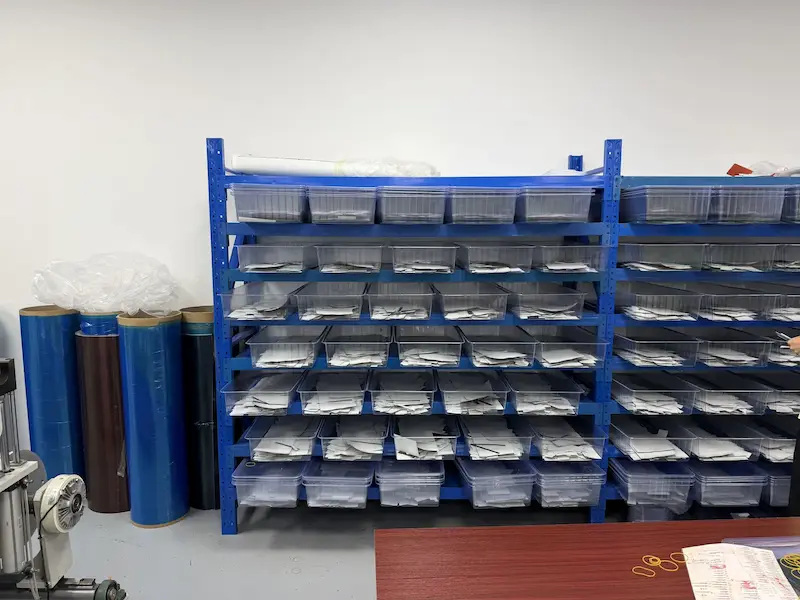
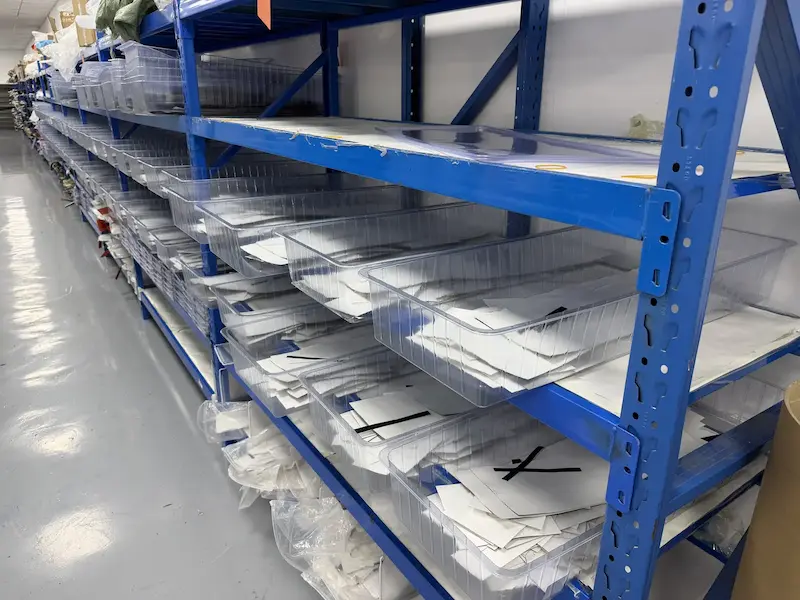
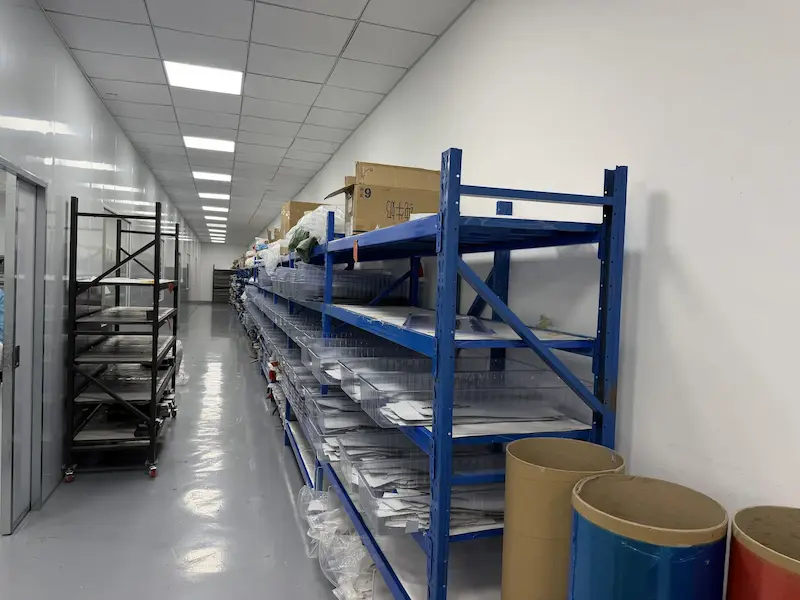
Prepreg is carbon fabric that has already been impregnated with a precisely metered amount of uncured resin. It is the reason hand layup can produce a consistent frame: the resin-to-fibre ratio is set by the material supplier rather than by the operator's brush.
That precision comes with obligations. Uncured resin has a shelf life and advances faster when it is warm, so prepreg has to be stored cold, brought up to working temperature in a controlled way, and used within its working window. Cut plies that sit too long become stiff and will not conform properly into the mould, which shows up later as voids or dry spots.
- Cold storage with batch records for every roll
- Controlled thaw and working time before layup
- Ply nesting designed so fibre orientation is repeatable
- Cut plies tracked back to the frame batch
- Resin-to-fibre ratio fixed by the prepreg specification
- Out-of-window material removed rather than worked around
How we choose the material for a frame
Material selection is a conversation about targets, not a ranking of grades. Before we propose a material and layup combination we need answers to six questions.
| Question | Why it changes the material decision |
|---|---|
| Target frame weight | A weight target decides how much fibre you can afford. Below a certain point, T800 will not get you there and a T1000 layer becomes necessary. |
| Rider or system weight and loading | Higher loads need thicker walls and often a tougher fibre. On e-bike frames the motor torque and battery mass change the whole load case. |
| Terrain and impact exposure | Gravel and MTB frames meet stone strike and crash loads that road frames rarely see. Impact tolerance argues for T800 in the exposed zones. |
| Stiffness target | Power transfer and steering precision are stiffness problems. Once the geometry is fixed, higher-modulus fibre is one of the few levers left. |
| Ride quality target | Comfort is engineered by allowing controlled flex, not by adding material. That is a layup decision, and it interacts directly with the grade you pick. |
| Test standard and market | Frames destined for markets with stricter requirements, or e-bike platforms, are specified with more margin from the outset rather than being reinforced later. |
Once those are settled we build a ply schedule, then validate it. Validation means testing the actual frame, not running a simulation and calling it done — see testing and certifications for the protocol, and carbon layup design for how the schedule itself is built.
Carbon fiber FAQ
No. T1000 gives more stiffness and strength per gram, which is a real advantage for a racing frame with an aggressive weight target. But it is also less forgiving of impact, and on a gravel or MTB frame that matters. For most riders and most terrain, a well-designed T800 frame with a good layup will outperform a poorly designed T1000 frame, and cost less.
No. The grade is one input. Ply schedule, wall thickness, resin content, cure profile and the dimensional accuracy of the finished frame all change the result. Two frames with identical material specifications can behave completely differently. This is why we publish the test protocol rather than leaning on the material name.
Our production range is built around Toray grades, and the material for each model is listed in the tables above and on the product page. If a project requires a different fibre specification, we will tell you what is possible and what changes as a result.
Material batch records are kept against each frame batch and can be provided for OEM orders. If you need material certification as part of your own compliance documentation, raise it at the quotation stage so it can be built into the order. Contact us to discuss what documentation you need.
They solve different problems. Monocoque construction, which is what we use, cures the frame as a single structure so there are no bonded tube joints to become a weak point, and it allows the tube shapes and wall thicknesses to be shaped freely. It requires more tooling investment, which is why it suits series production rather than one-off builds. See EPS molding technology for how the internal core is handled.
Ask about carbon material options
Tell us your target weight, terrain and stiffness requirement. We will tell you which grade and which mix we would recommend, and what it does to the frame weight and cost.
- Grade and layup recommendation
- Material batch records on request
- Reply within one working day