
Carbon Bike Frame Manufacturing Process
One frame passes through eight production stages between the material store and the shipping carton. This page follows that route, and names the control point at each stage — the thing that has to be right before the frame is allowed to move on. If you are assessing a supplier, these are the stages to ask about.
Eight stages, from prepreg roll to packed frame
A carbon frame is a chain of dependent steps. A perfect layup will still fail if the cure profile is wrong; a perfect cure will still be rejected if the bottom bracket face is not parallel. Here is each stage and the control that protects it.
Material receiving & cold storage
Toray prepreg is received with batch records and stored in a temperature-controlled room so the resin never advances before it is used.
CNC fabric cutting
Rolls are cut on a CNC cutting table. Every ply is cut from a digital nest, which is what keeps ply shape and fibre orientation repeatable between batches.
Layup & preforming
Cut plies are laid up in the ordered schedule, then preformed and wrapped so the stack holds its shape before it goes into the tool.
Molding & curing
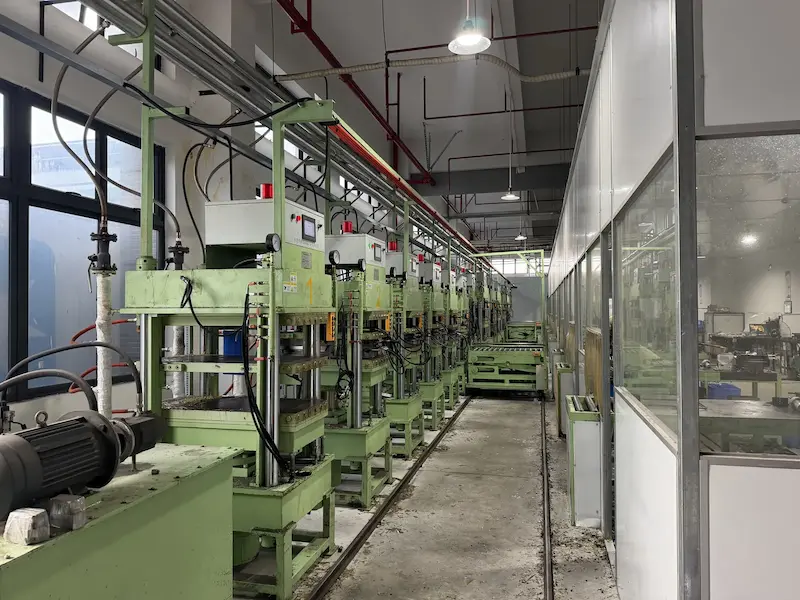
The layup goes into a heated steel mould and is cured under pressure. Cure profile, pressure and temperature are the three variables that decide the mechanical result.
Demolding, trimming & surface prep
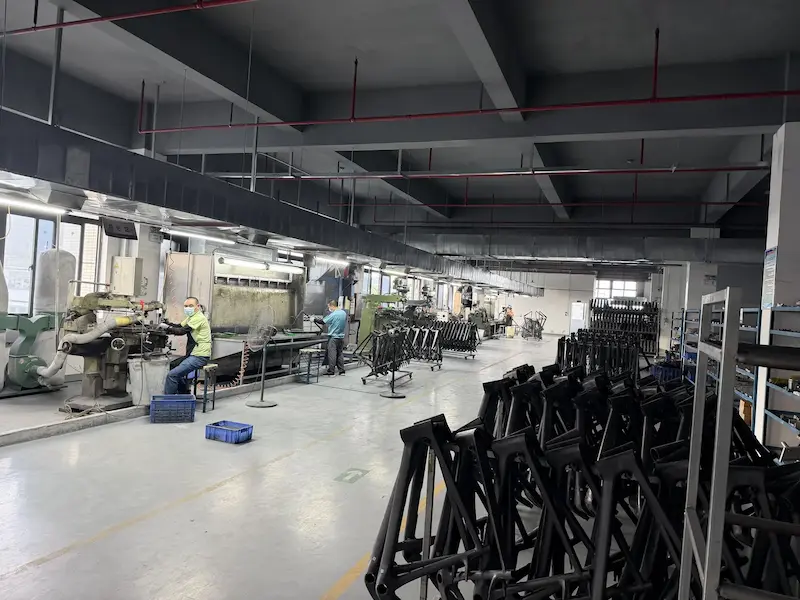
Frames are demolded, trimmed, and the bonding surfaces are abraded and cleaned before assembly.
Bonding & machining
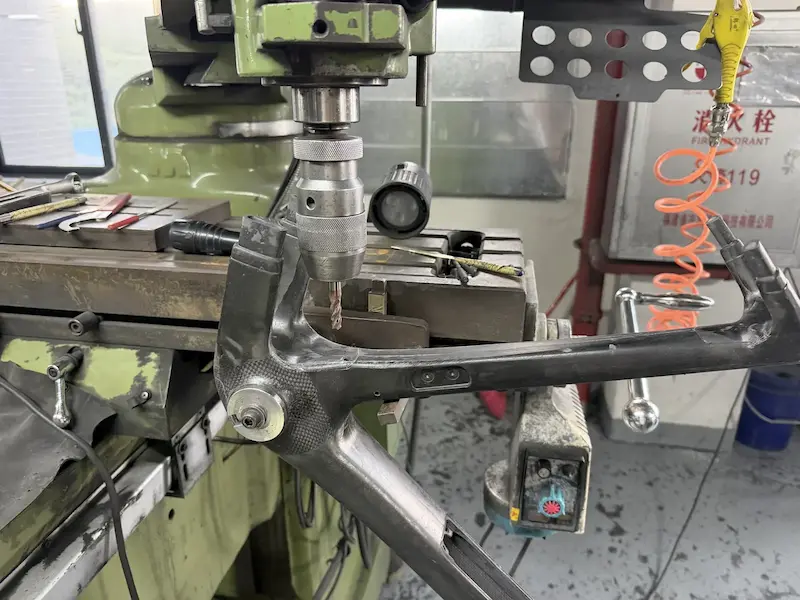
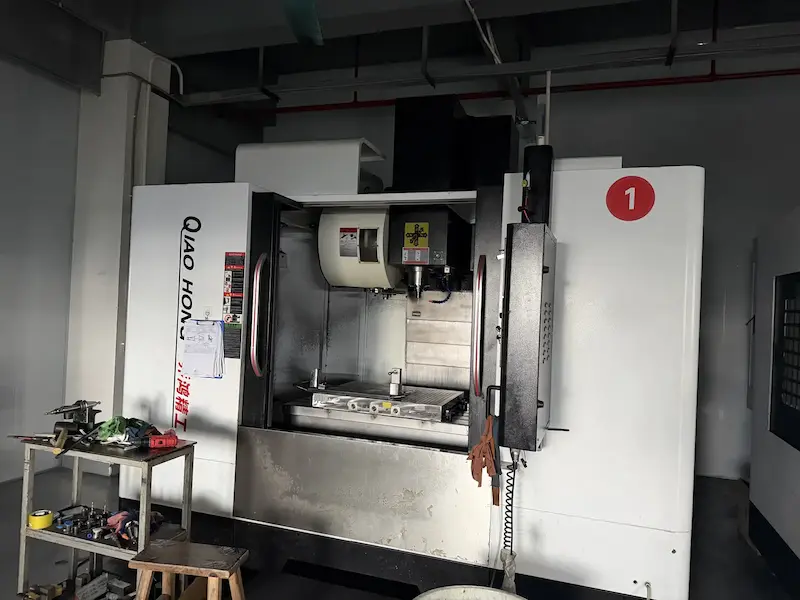
Sub-assemblies are bonded in fixtures, then bottom bracket shells, head tubes and dropouts are faced, reamed and machined on CNC centres.
Painting & finishing
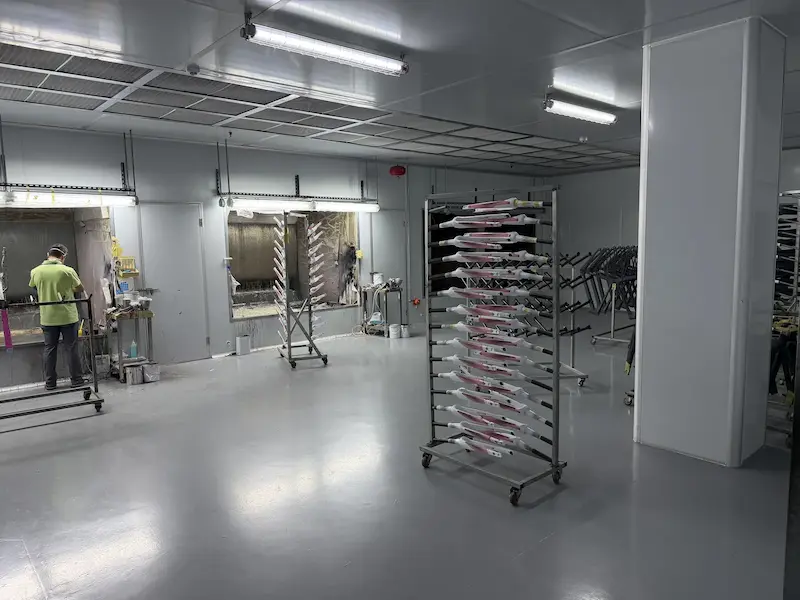
Frames are sprayed in dedicated booths and cured in temperature-controlled ovens. Paint is also a corrosion and UV barrier, not only a finish.
Quality control & packing
Dimensional, alignment and finish checks are completed against the batch record, then frames are assembled, protected and packed for shipping.
The stations behind those eight stages
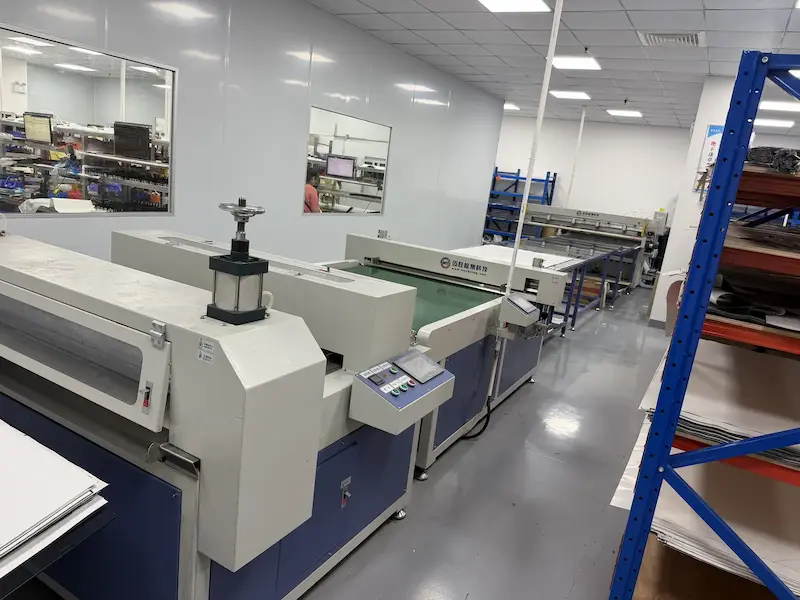
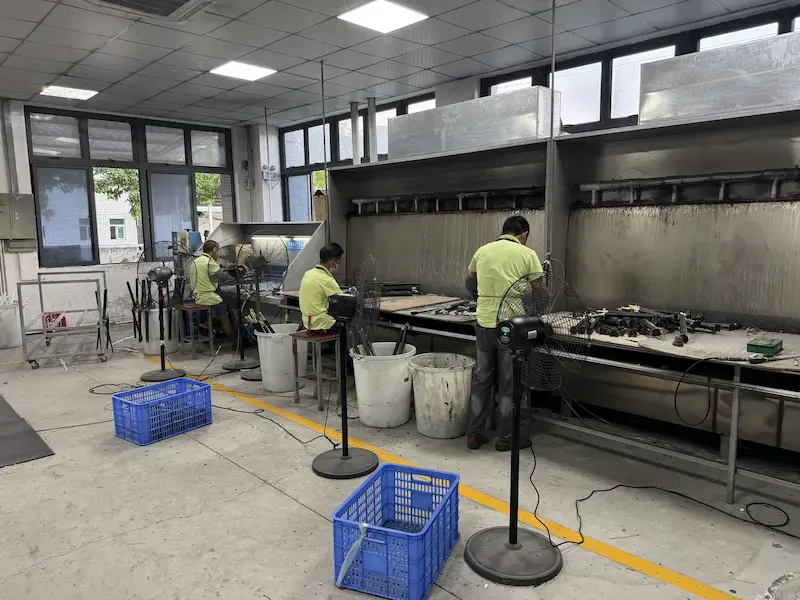
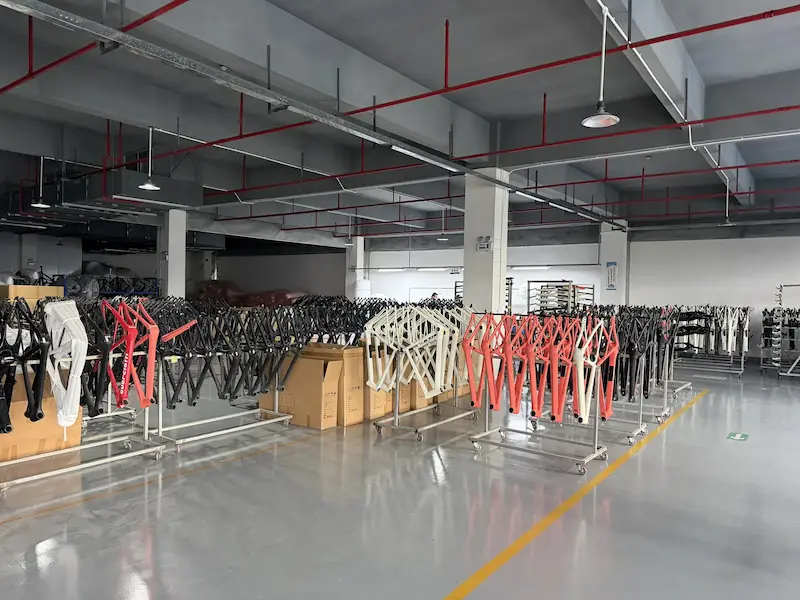
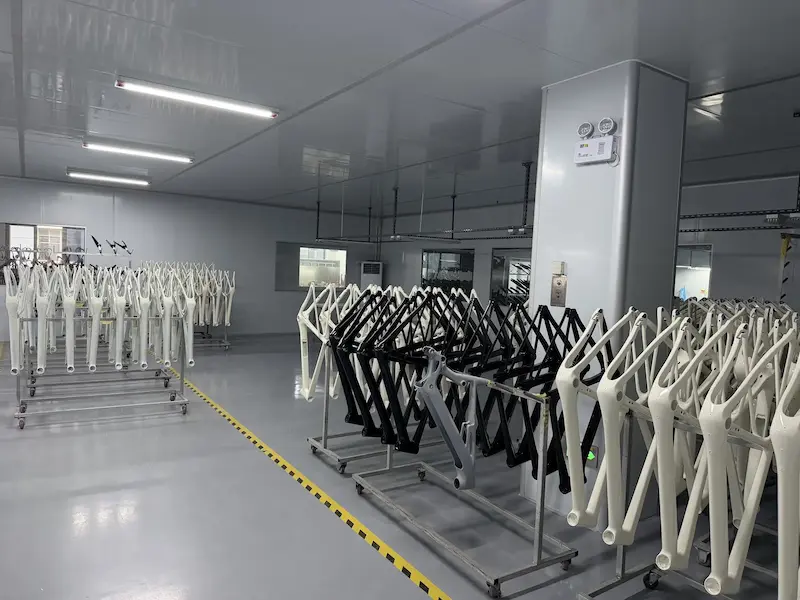
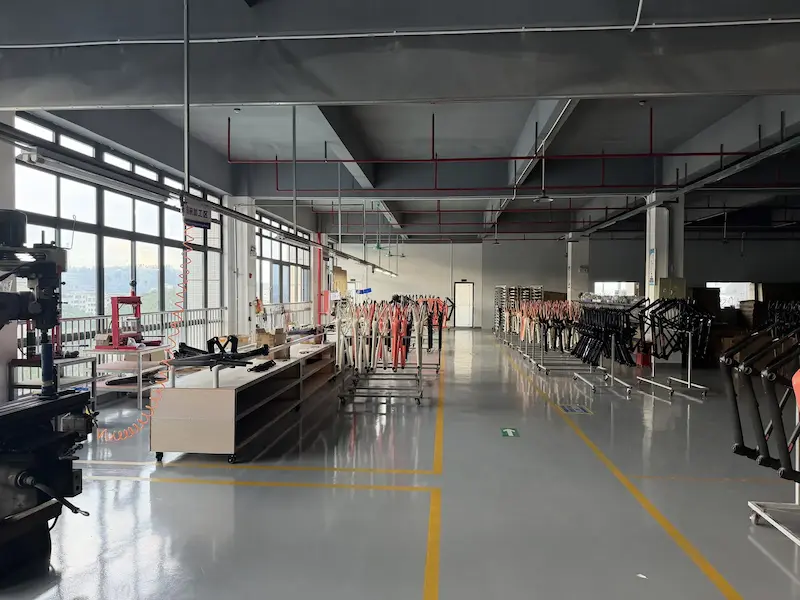
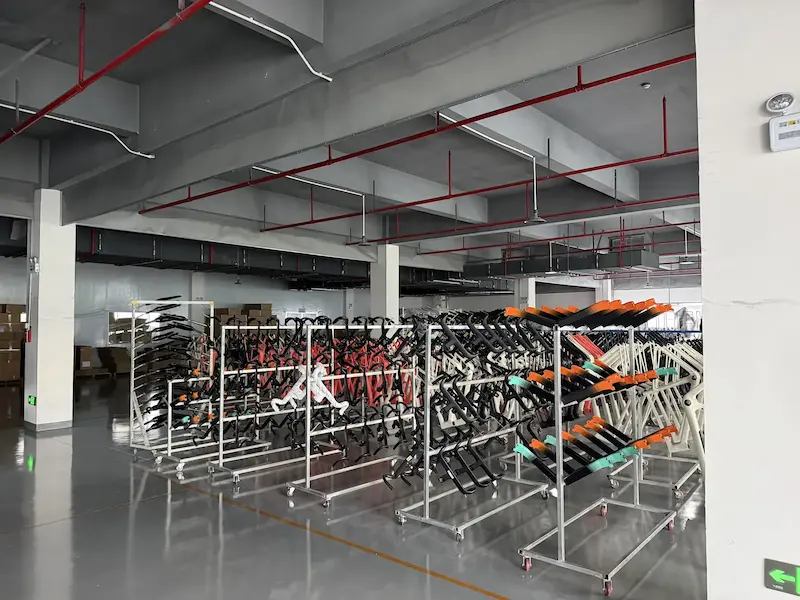
These photographs are from our own production line in Huizhou. They are here so you can match a claim to a machine rather than to a brochure.
Painting: a coating system, not a coat of colour
Paint on a carbon frame does three jobs. It defines the brand, it protects the laminate from UV and abrasion, and on a gravel frame it has to survive stone strike without chipping down to the fibre. That makes it a process, not a step.
Frames are sprayed in dedicated booths by operators working to a paint specification, then cured in temperature-controlled ovens. Colour matching to RAL or Pantone systems, decals and multi-colour schemes are all handled in-house, which is why custom graphics do not have to be outsourced or sent away for a second pass.
Why the cure step matters as much as the spray
Paint that has not cured properly looks correct on the day it is packed and fails months later, usually as chipping around the dropouts and bottom bracket where the bike is handled most. Curing in a controlled oven rather than letting frames air-dry is what makes the coating system durable.
It also protects the frame underneath. A carbon laminate is protected from UV and moisture by the resin matrix and the paint on top of it. A poor coating system is a long-term structural problem, not just a cosmetic one.
Custom painting and decals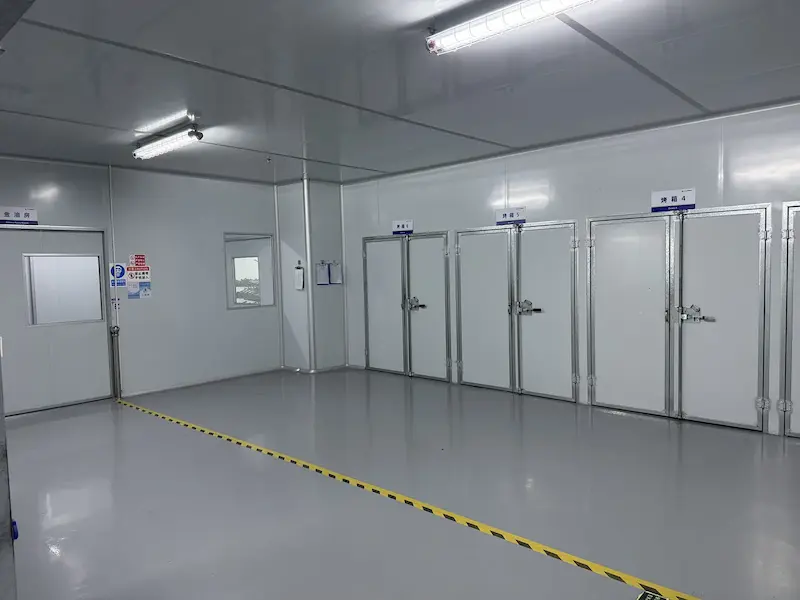
The last stage is the one your customer actually sees
A frame can survive the whole factory and still arrive damaged. Packing is specified per order rather than improvised at the end of the line, and it is where a surprising amount of a supplier's real quality shows.
- Frames protected at the dropouts, bottom bracket and head tube
- Fork, seatpost and small parts packed separately where required
- Paint-protection film or foam wrapping on finished surfaces
- Carton configuration matched to shipping method and pallet plan
- Retail-ready or OEM bulk packing, depending on your channel
- Carton marking and labelling to your specification
How to use this page when you are evaluating a supplier
Whichever factory you are assessing, the useful questions are the same. A supplier who controls the process can answer them with specifics; one who assembles from bought-in frames usually cannot.
| Question to ask | What a good answer includes |
|---|---|
| How are plies cut and verified? | CNC cutting from digital nests, with ply count and orientation checked before the mould closes — not scissors and a template. |
| What cure profile do you use, and is it recorded? | A defined temperature, pressure and dwell time per platform, recorded per batch and traceable to the frames in that batch. |
| Which steps happen in-house? | The more of cutting, layup, molding, bonding, machining, painting and testing that happens on site, the less opportunity there is for a defect to be hidden between suppliers. |
| How are bearing and thread interfaces machined? | On CNC stations to drawing, with the bottom bracket and head tube faces checked for parallelism afterwards — see quality control. |
| What is tested, and who signs it off? | A defined protocol per platform, run on the supplier's own rigs, plus third-party laboratory reports — see testing and certifications. |
Want to see it rather than read it?
Factory audits and video walkthroughs of the production line can be arranged for serious OEM enquiries, and samples can be produced from a specific platform so you can validate the process against a physical frame. Get in touch to arrange either.
The scale this process runs at
A process description is only useful if you can tell whether the factory behind it can run it at your volume. These are our numbers, and what each one means for a frame project.
| Item | Value | What it means for your project |
|---|---|---|
| Production base | 15,000 m² | Cutting, layup, moulding, bonding, machining, painting and packing under one roof. A frame does not travel between subcontractors, so a quality problem is caught at the next station rather than after a truck journey. |
| Monthly capacity | 6,000 frames | Roughly 72,000 frames a year. Enough headroom to absorb a programme launch without displacing existing production, which is usually the constraint that decides whether a new project can start on schedule. |
| Air compressors | 3 × 75 kW | Moulding presses and clamping systems draw on this supply. Insufficient or unstable compressed air is a common cause of inconsistent pressure during cure, which shows up later as wall thickness variation. |
| CNC machining centres | 10 | Bottom bracket shells, head tubes and dropouts are machined in-house rather than bought in, which keeps the interface tolerances inside one supply chain. |
| Employees | 280 | Includes 25 dedicated quality control staff — around 9% of the workforce, which is the number to look at when you are judging how seriously a factory treats inspection. |
Manufacturing process FAQ
Capacity depends on the platform and the finish level, and it is best quoted against a specific enquiry rather than as a single headline number. Send us the model, quantity and finish requirement and we will confirm what is achievable and when.
Our production is focused on framesets — frame, fork and associated hardware. Full bike assembly is not part of our standard offer, but we can discuss what is possible for a specific programme on the OEM page.
It depends on whether the project uses existing tooling or requires new moulds, and on the finish specification. Projects moving through existing platforms are considerably faster than new-tooling developments. We confirm a schedule with the quotation rather than quoting a blanket lead time.
Yes. We are in Huizhou, Guangdong, and visits can be arranged for OEM customers and serious enquiries. Where travel is not practical we can arrange a live video walkthrough of the relevant production areas instead. Contact us to arrange a visit.
Yes — logos, decals, colourways and carton branding are all produced to your artwork. Paint specifications can be matched to RAL or Pantone references. See OEM services for the full list of customisation options.
Start an OEM frame project
Tell us the platform, the target market and the finish level. We will come back with the production route, the tooling position and a schedule you can plan against.
- Factory visits and video walkthroughs
- Existing platforms or new tooling
- Reply within one working day