
Carbon Bike Frame Testing & Certifications
Testing is the only part of a frame's specification that a buyer cannot verify by looking at it. This page explains which standards apply, what each test actually simulates, what our 1.3× ISO 4210 protocol means and — just as importantly — what a passing test does not prove.
What a frame test proves, and what it does not
A frame test is a defined load case applied a defined number of times, with a defined pass or fail result. That is what makes it useful: it is repeatable, comparable and independent of opinion. It is also what limits it.
A frame that passes a fatigue test has demonstrated that it survives that specific loading pattern for the required number of cycles. It has not been proven indestructible, and it has not been proven to survive a crash, an impact it was never designed for, or a badly fitted component. Any supplier who presents a test certificate as a blanket guarantee of safety is overstating what the test says.
The useful question is not "is it tested" but "tested to what"
Almost every frame on the market has been tested against something. What matters is which standard, which test types, what the frame was configured with, and whether the result came from the factory's own rig or an independent laboratory. Those four details are what turn a test into evidence.
The standards that apply to a carbon frame
| Standard | Applies to | What it covers for a frame |
|---|---|---|
| ISO 4210-2:2023 | City and trekking, young adult, mountain and racing bicycles | The requirements a frame has to meet. Clauses 4.8.2 to 4.8.7 are the frame requirements; 4.9.4 to 4.9.8 are the fork requirements. |
| ISO 4210-6:2023 | The same four bicycle categories | The test methods that demonstrate the above. Clauses 4.1 to 4.6 cover frame testing; 5.1 to 5.8 cover fork testing. |
| EN 15194:2024 | Electrically power assisted cycles (EPAC) | The standard for pedal-assist e-bikes, which adds the loads created by motor torque and a heavier system mass. |
| EN 17404:2022 | Electrically power assisted mountain bikes (E-MTB) | The E-MTB specific case. A standard EPAC test does not cover the impact loads an E-MTB sees. |
| 16 CFR 1512 | Bicycles sold in the United States | The US Consumer Product Safety Commission requirements, which a frame entering the US market has to satisfy independently of the EN route. |
| ISO 11243:2024 | Luggage carriers | Applies where a carrier is fitted as original equipment, which also loads the frame. |
Which standard applies to your frame is decided by the market and the category you sell it into. If you are unsure which one your product falls under, we can tell you what we test to and why. See certification for the documents we can provide.
The older EN 14764, EN 14766 and EN 14781 standards are withdrawn
These three are still quoted by suppliers, and they are the standards you will find in older test reports. They were the European city and trekking, mountain, and racing bicycle standards, and they were superseded by the EN ISO 4210 series. A report that cites them describes a standard that is no longer current, and a laboratory that lists them in its current scope of accreditation is worth a second question.
“ISO 4210” is not one test. Which category you fall into changes the numbers.
ISO 4210 is written for four bicycle categories — city and trekking, young adult, mountain, and racing. Each has its own load values inside the same standard, and the gap between the lightest and the heaviest is large.
| Load case | Clause | City / trekking | Young adult | Mountain | Racing |
|---|---|---|---|---|---|
| Frame impact — drop height | 4.1 | 180 mm | 180 mm | 360 mm | 212 mm |
| Pedalling fatigue force | 4.3 | 1,000 N | 1,000 N | 1,200 N | 1,100 N |
| Horizontal fatigue, forward | 4.4 | 450 N | 450 N | 1,200 N | 600 N |
| Vertical fatigue force | 4.5 | 1,000 N | 500 N | 1,200 N | 1,200 N |
| Rear brake mount, static load | 4.6.2 | 700 N | 700 N | 700 N | 700 N |
Values as recorded in an accredited third-party test report on our gravel platform, which sets out the requirement for all four categories side by side.
There is no gravel category in ISO 4210
Gravel is not one of the four categories, so a gravel frame has to be tested against one of the existing ones, and which one is the manufacturer's choice. The industry default for a drop-bar frame is racing, and that is the category our gravel platform is tested to. It is a defensible choice, but it is worth being explicit about what it does and does not demonstrate: a frame tested to the racing cases has not been shown to survive the mountain-category impact case, which is a 360 mm drop against 212 mm.
If your market or your own compliance process needs the mountain-tier impact load case on a gravel frame, say so at the enquiry stage and we will scope the programme rather than assume the default is enough.
What “1.3× ISO 4210” actually means
You will see this claim on our certification page and on some of our product pages, so it is worth being precise about it rather than leaving it as a marketing number.
| Term | What it means |
|---|---|
| The standard test force | Each test in the standard specifies a load, a direction and a number of cycles that the frame must survive without cracking or excessive permanent deformation. |
| Our 1.3× protocol | For our own release testing we apply 1.3 times that specified force to the same load case. In practice, a frame has to survive 130% of what the standard requires before we consider the platform released. |
| What it is not | It is an internal engineering margin, not a different certification. It does not change which standard applies to your market, and it is not a substitute for third-party type approval where your market requires it. |
| Why we do it | Frames are used harder than the test assumes: heavier riders, luggage, rough terrain, poor maintenance. Building in margin against the standard is a deliberate choice about how much real-world abuse the frame should absorb. |
The left column is what the standard requires. The right column is 1.3 times that value, applied to the same load case under our own release protocol.
| Load case | Clause | ISO 4210-6:2023 | 1.3× release protocol |
|---|---|---|---|
| Fatigue with pedalling forces | 4.3 | 1,100 N | 1,430 N |
| Fatigue with horizontal forces, forward | 4.4 | 600 N | 780 N |
| Fatigue with horizontal forces, rearward | 4.4 | 600 N | 780 N |
| Fatigue with a vertical force | 4.5 | 1,200 N | 1,560 N |
| Static rear brake torque, rearward | 4.6.2 | 700 N | 910 N |
| Static rear brake torque, forward | 4.6.2 | 300 N | 390 N |
| Rear brake mount fatigue, rearward | 4.6.3 | 500 N | 650 N |
| Rear brake mount fatigue, forward | 4.6.3 | 50 N | 65 N |
| Fork static bending | 5.3 | 1,200 N | 1,560 N |
| Fork bending fatigue | 5.5 | ±620 N | ±806 N |
| Fork static brake torque | 5.6.2 | 1,000 N | 1,300 N |
| Composite fork disc brake mount | 5.6.4.2 | 600 N | 780 N |
The 1.3× margin applies to the forces. It is an internal release criterion, not a certification, and it does not change the standard your frame is declared against.
What each test simulates on the road or trail
A frame test is a stand-in for a real load that is too slow or too variable to reproduce by riding. These are the load cases and what each one represents.
| Test | What is applied | What it stands in for |
|---|---|---|
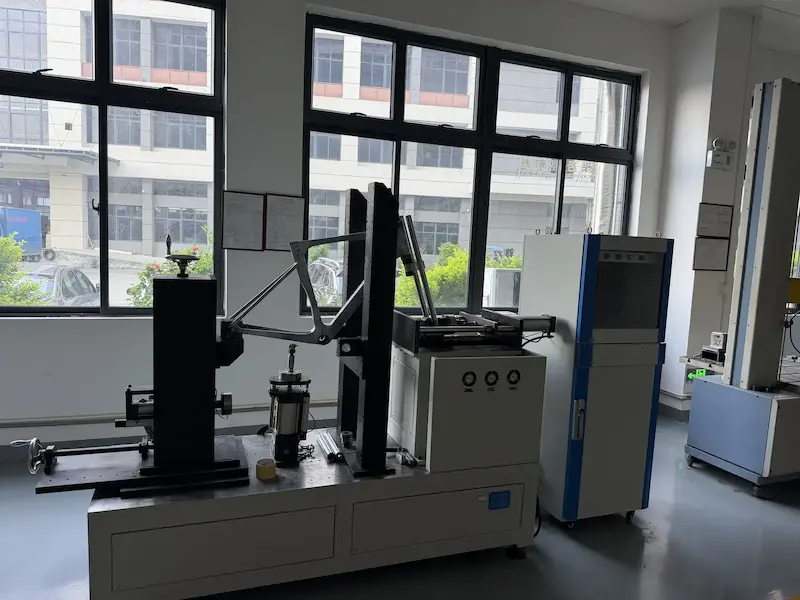
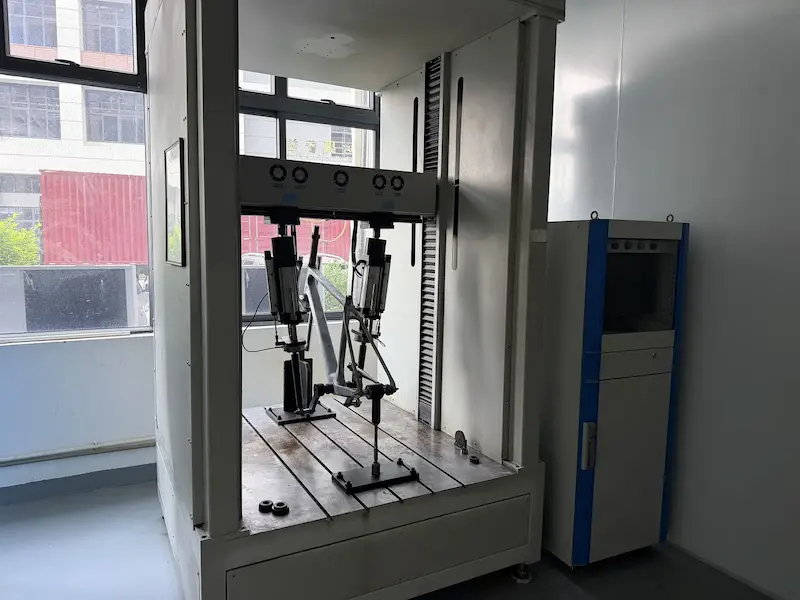
| Frame fatigue test | Repeated pedalling and vertical loads applied through the bottom bracket and dropouts over a large number of cycles. | Years of riding. Fatigue is the failure mode that matters most for a frame that has to stay safe over a long service life. |
| Vertical load test | A static load applied vertically at the rear dropouts. | Rider weight over the rear wheel, including a rider hitting a pothole or a root. |
| Horizontal load test | A static load applied sideways and fore-aft. | The racking forces from hard cornering, sprinting and out-of-the-saddle climbing. |
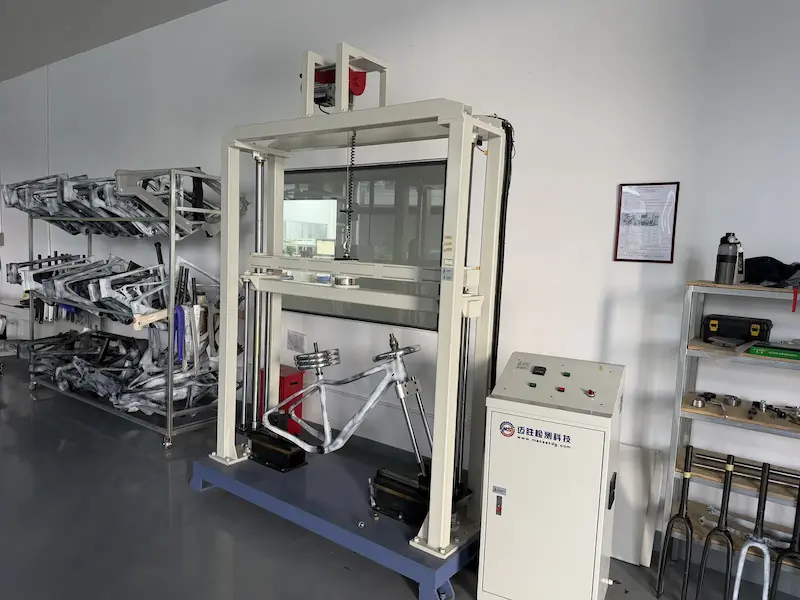
| Falling mass impact test | A weighted mass dropped onto the frame or fork in a defined position. | The impact of hitting a kerb, a rock or a log — the failure mode most likely to end a ride immediately. |
| Fork static and fatigue tests | Bending loads applied to the fork with the steerer clamped. | Braking forces and front wheel impacts. Fork failure is the most dangerous failure on a bicycle, so this test carries the largest margin. |
| Seatpost and seat tube tests | Loads applied through a mounted seatpost at the saddle position. | Rider weight on the saddle, including the leverage of a long post or a heavily loaded bikepacking setup. |
| E-bike specific load cases | Additional load cases accounting for motor torque and higher system mass. | The specific demands of a pedal-assist platform, which a non-assisted frame test does not represent. |
In-house testing and third-party testing are different things
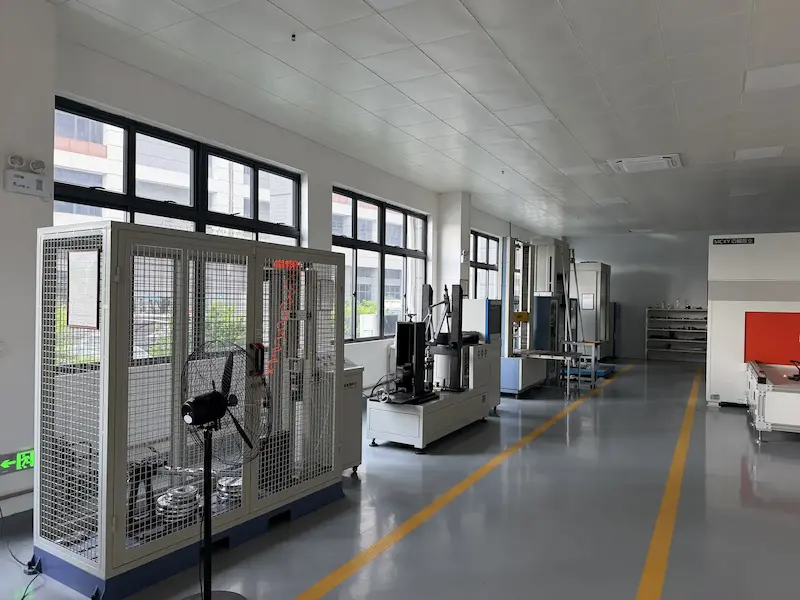
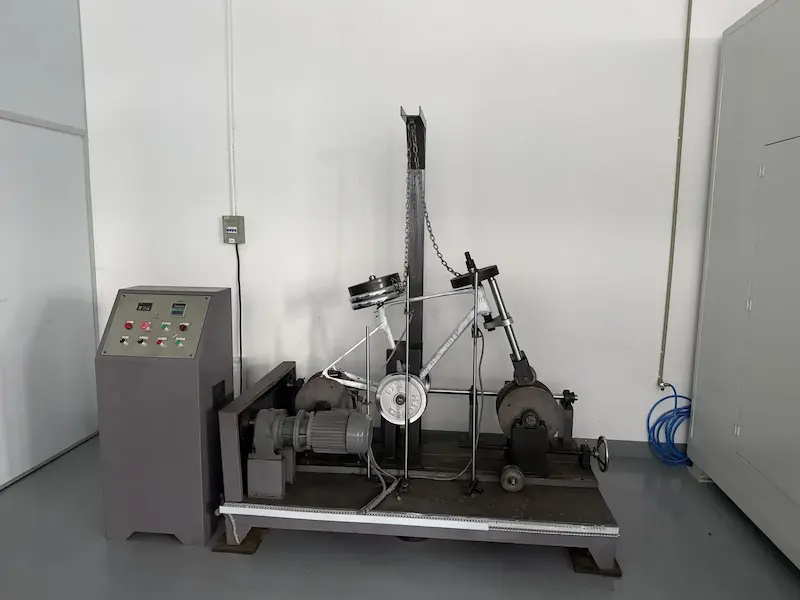
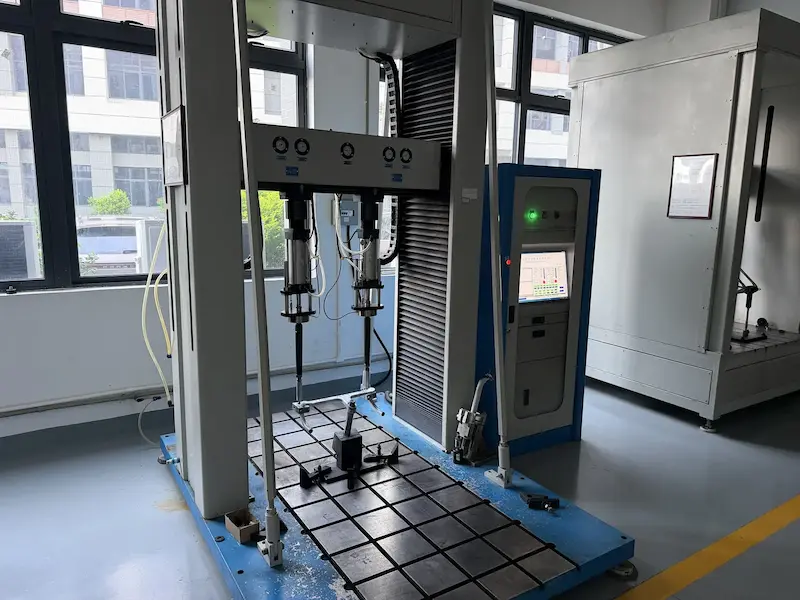
Both matter, and they answer different questions. In-house testing lets a factory iterate quickly and catch problems at the platform development stage. Third-party testing removes the factory from the judgement of its own product, which is what a distributor or a brand's compliance team usually needs.
| In-house testing | Third-party testing | |
|---|---|---|
| Purpose | Platform development, batch verification and root-cause analysis. | Independent verification for a market, a retailer or a brand's own compliance file. |
| Advantage | Fast iteration and full visibility of the data behind a failure. | The result is not judged by the party that made the product. |
| Limitation | Interpretation sits with the manufacturer. | Slower and more expensive per test, so it is used at defined points rather than continuously. |
We use both. Our own rigs run the 1.3× protocol during development and for platform verification, and certified third-party laboratory reports are commissioned where a market or a customer requires independent documentation. The reports we hold are listed on the certification page, and further reports can be requested for a specific project.
Need a test report for your compliance file?
If you are a distributor, a brand or a retailer and need testing to a specific standard, for a specific configuration, or witnessed by a third party, tell us at the enquiry stage. It is much easier to plan a test programme into a project than to add one afterwards. View our certification details or contact us.
A gravel platform put through the complete ISO 4210 frame and fork protocol
This is the scope of a completed test programme on our FM286 gravel platform, carried out at an accredited third-party laboratory in Taiwan in 2025. Every clause below passed.
Frame — 7 of 7 clauses passed
| Test | ISO 4210-6 | Applied | Result |
|---|---|---|---|
| Frame impact (falling mass) | 4.1 | 22.5 kg striker, 212 mm drop | Pass 4.1 mm permanent set, no cracks |
| Frame and fork impact (falling frame) | 4.2 | 30 / 10 / 50 kg masses, 200 mm drop | Pass 4.5 mm permanent set, no cracks |
| Fatigue with pedalling forces | 4.3 | 1,100 N, 100,000 cycles | Pass no cracks |
| Fatigue with horizontal forces | 4.4 | 600 N forward / 600 N rearward, 100,000 cycles | Pass no cracks |
| Fatigue with a vertical force | 4.5 | 1,200 N, 50,000 cycles | Pass no cracks |
| Static rear brake torque | 4.6.2 | 700 N rearward / 300 N forward, 1 min each | Pass no cracks |
| Rear brake mount fatigue | 4.6.3 | 500 N rearward / 50 N forward, 20,000 cycles | Pass no cracks |
Fork — 8 of 8 clauses passed
| Test | ISO 4210-6 | Applied | Result |
|---|---|---|---|
| Fork tensile test | 5.2.2 | 5,000 N | Pass no detachment or loosening |
| Fork static bending | 5.3 | 1,200 N | Pass 1.46 mm permanent deformation |
| Fork rearward impact (composite fork) | 5.4.1 | 640 mm drop | Pass 11.9 mm deformation, cracks within criteria |
| Fork torque test | 5.4.3 | 80 N·m | Pass no relative movement |
| Fork bending fatigue | 5.5 | ±620 N, 100,000 cycles | Pass no cracks |
| Rearward impact after fatigue | 5.4.1 | 640 mm drop | Pass 21.6 mm deformation, cracks within criteria |
| Static brake torque | 5.6.2 | 1,000 N, 365 mm arm | Pass no cracks |
| Composite disc brake mount fatigue | 5.6.4.2 | 600 N — 1,000 cycles at 100 °C, then 19,000 cycles at ambient | Pass no cracks |
Why the fork impact result says “cracks within the criteria”
The fork impact test recorded permanent deformation and visible cracks, and still passed. That is not a failure being explained away — it is how the standard is written for composite forks. A carbon fork is expected to absorb impact energy by deforming and delaminating locally rather than by staying pristine, and the criterion is that the damage stays inside a defined limit and that the fork does not separate. A report claiming a composite fork survived a 640 mm impact with no damage at all is worth questioning.
The disc brake mount was tested hot, not cold
ISO 4210-6:2023 clause 5.6.4.2 requires the first 1,000 cycles of the fork disc brake mount fatigue test to be run at 100 °C, because that is roughly the temperature a brake mount reaches under sustained braking. The reason is in the standard: carbon fibre changes state above its glass transition temperature, so a composite brake mount that is only ever tested cold has not been tested in the condition it will actually see. Our fork passed the 100 °C stage and the 19,000 ambient cycles that follow it.
- Sources for this page
- ISO 4210-2:2023 — Cycles: Safety requirements for bicycles, Part 2: Requirements for city and trekking, young adult, mountain and racing bicycles.
- ISO 4210-6:2023 — Cycles: Safety requirements for bicycles, Part 6: Frame and fork test methods.
- Accredited third-party test programme on the FM286 gravel platform, Taiwan, October–November 2025. Report references available to trade customers on request.
- EFBE Prüftechnik GmbH, list of test methods within the scope of DAkkS accreditation, revision 1.1, 5 June 2025 (used to confirm which editions of the EN ISO 4210 series and the EN 14764 / 14766 / 14781 series are current).
The test reports behind this programme were issued to the customer who commissioned them, so they are not reproduced here. We can confirm the scope and the outcome for the platform you are buying, and where you need a report you can publish under your own brand, we can arrange testing in your name.
Testing and certification FAQ
Our frames are tested against the applicable standards for their category, and EN certification together with third-party laboratory reports are part of how we document that. The specific documents we hold, and what each one covers, are set out on the certification page. If you need a certification that applies to a specific market, tell us which one and we will confirm what we can provide.
A tested frame has been shown to survive defined load cases, which is a meaningful and verifiable statement. It is not a guarantee against every possible outcome. Crashes, impacts outside the tested load cases, incorrect assembly and damage from crashes elsewhere can all still cause failure. Testing reduces risk; it does not eliminate it.
No — that is a common misreading. It means the frame survived 1.3 times the specified test force in that load case. It does not translate into a percentage figure for the frame's strength in every situation. What it does tell you is that the frame was released with margin above the standard rather than exactly at it.
Test documentation is available for OEM and trade enquiries. Some reports are specific to a customer's configuration and cannot be shared directly, so we will tell you what can be released for the model you are interested in. Contact us with the model and the market.
Destructive testing is done on samples, because the frame does not survive it. Platform release testing and periodic batch verification are done on frames drawn from production rather than from a hand-built sample, so the result reflects what customers actually receive. Dimensional and finish checks, by contrast, are applied to the frames themselves — see quality control.
View certification details or request a report
Tell us the model, the market and the standard you need to satisfy. We will confirm what testing has been done, what documentation we can provide, and what would be required for anything additional.
- Reports for OEM and trade enquiries
- Third-party testing arranged on request
- Reply within one working day