

Gravel Bike Size Chart: Start with Height, Confirm on the Geometry Chart
This chart gives a starting gravel frame size range from your height. Use it to narrow the choice; it is not a guaranteed size for a specific FM model.
- Start by measuring your height and your inseam. Riding inseam is not pant length: it is the height from the crotch to the floor when you stand barefoot.
- Then open the geometry chart for your target model and check stack, reach, standover, and whether the page publishes a seatpost insertion range.
- After you have checked the geometry, compare gravel or road frames by intended use on the category pages.
- If you are still unsure which size to choose, send us your height, inseam and target model and we will help you check.
The same size label is not interchangeable
The same “54” or the same “M” does not mean the geometry is the same. Handlebar height and how far forward the bars sit can differ a lot, so these labels are not interchangeable sizes.
- The centimetre size you read from height only shortlists one or two candidate sizes.
- For a different brand, a different category, or even a different platform from the same brand, open the geometry chart for that model and that size.
- Before you order, at least check stack, reach and standover, and see whether the page publishes a seatpost insertion range.
- If you already have a bike that fits you well, comparing its stack and reach is more useful than looking at height alone.
- Do not derive a gravel size from a road size by adding or subtracting a fixed number of centimetres, or the other way around.
- If another page still says “subtract 1–2 cm for gravel”, do not follow that. Use the starting chart on this page and the geometry chart for your target model.
Source: Cyclist’s “Stack and reach explained” compares traditional size labels to shoe sizes from different brands: the same number does not line up. It compared a Specialized Tarmac and a Trek Émonda that are both labelled 56 cm: the Tarmac had a stack of 555 mm and a reach of 398 mm; the Émonda had a stack of 563 mm and a reach of 391 mm — 8 mm taller and 7 mm shorter.
https://www.cyclist.co.uk/in-depth/how-to-measure-stack-and-reach
BikeRadar’s “Gravel bike geometry and sizing” says reach and stack are the more useful numbers when you compare different frames. Its example: a 54 cm Marin Headlands with 372.7 mm reach and 581.8 mm stack, against a Specialized Crux at a similar size with 388 mm reach and 560 mm stack.
https://www.bikeradar.com/advice/sizing-and-fit/gravel-bike-geometry-sizing
How to measure height and inseam
Riding inseam is not pant length: it is the height from the crotch to the floor when you stand barefoot. The method is the same as on the bike frame size calculator, and both pages use the same wording.
Before you measure, keep these points consistent:
- Level floor, against a wall, barefoot
- Use centimetres
- Measure twice; if the readings differ by more than about 1 cm, measure a third time and use the stable reading
To measure height:
- Stand barefoot against a wall, with your heels, hips and shoulder blades lightly touching the wall, and look straight ahead
- Place a book or a square level on the highest point of your head and mark the wall
- Measure from the floor to that mark and record the centimetres
To measure inseam:
- Stand barefoot with your feet slightly apart; do not force a wide stance
- Hold a hardback book between your legs, spine up, with the top edge level
- Press it up gently to the crotch; do not yank
- Measure from the floor to the top of the book; that is your inseam
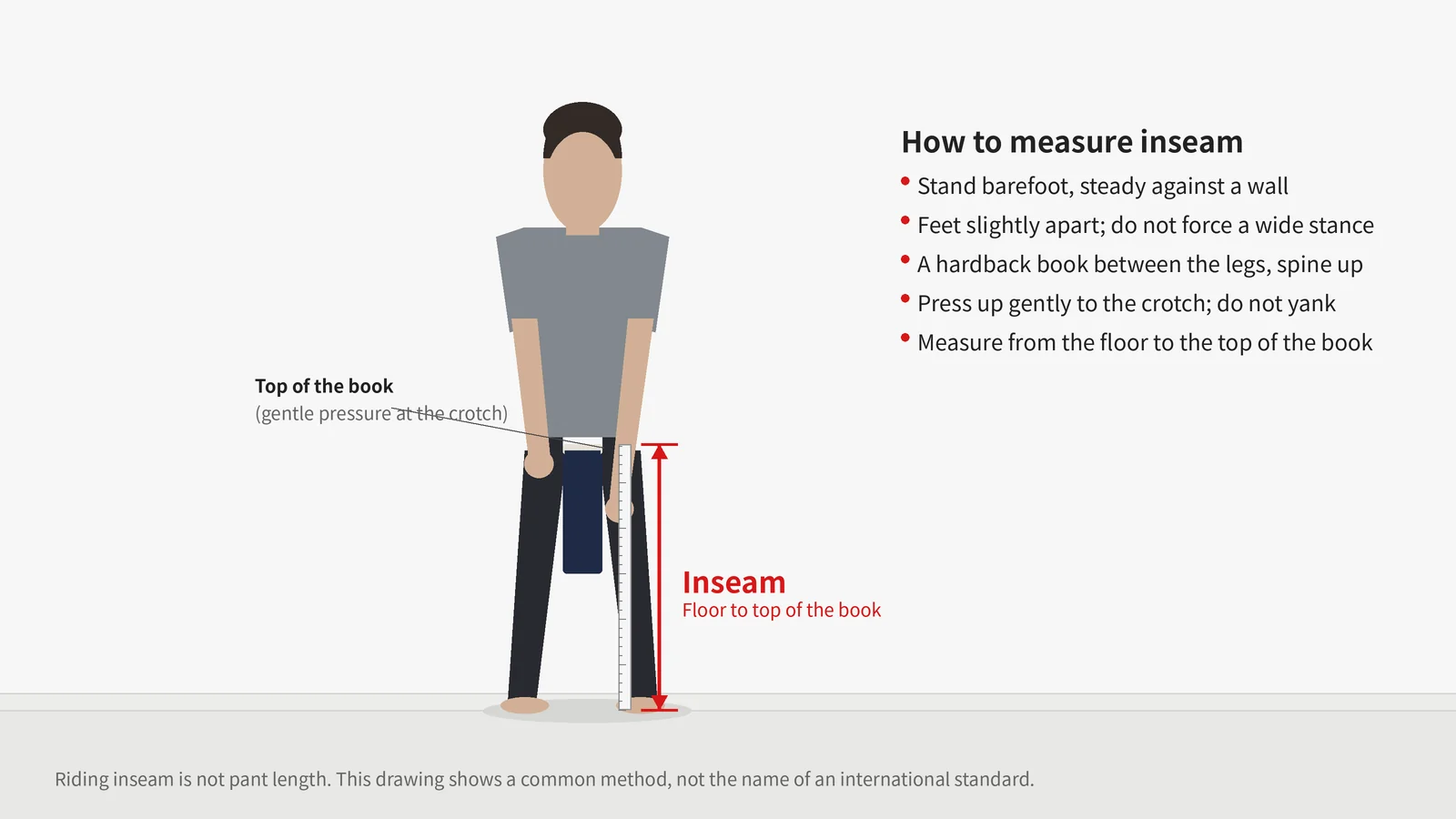
The calculator uses inseam only to refine a starting result. Even if you measure height first, you should still measure inseam before you check the geometry chart.
Source: Standing barefoot against a wall, pressing a book up to the crotch, and measuring from the floor to the top of the book is a common method. Ergon and the UK community enterprise Get Cycling both publish guides. This is not the name of an international standard. On this page, the effort is gentle upward pressure, not a hard yank.
https://www.ergonbike.com/en/magazine/calculate-optimal-frame-size
https://www.getcycling.org.uk/wp-content/uploads/2021/11/Inseam-Measuring-Guide.pdf
Gravel height-to-size chart
The table uses the height ranges already published on this page; the numbers have not been changed. These are general starting ranges to narrow the choice, not a guaranteed size for a specific FM model.
- A model’s own size guide may be narrower, or may sit one size away; the geometry chart for that model is what counts.
- A height that sits on a boundary, such as 170 cm or 175 cm, can belong to both adjacent starting ranges.
- In that case, do not pick the larger or smaller size from height alone. Open the geometry rows for both adjacent sizes on your target model.
- If your height falls outside both ends of the table, do not extrapolate a size. Send us your height, inseam and target model, or first check on the category pages which sizes that model actually offers.
| Height (cm) | Height (ft/in) | Gravel frame starting size (cm) |
|---|---|---|
| 155 - 160 | 5'1" - 5'3" | 47 - 49 cm |
| 160 - 165 | 5'3" - 5'5" | 49 - 51 cm |
| 165 - 170 | 5'5" - 5'7" | 51 - 53 cm |
| 170 - 175 | 5'7" - 5'9" | 53 - 55 cm |
| 175 - 180 | 5'9" - 5'11" | 55 - 57 cm |
| 180 - 185 | 5'11" - 6'1" | 57 - 59 cm |
| 185 - 190 | 6'1" - 6'3" | 59 - 61 cm |
| 190 - 195 | 6'3" - 6'5" | 61 - 63 cm |
Source: The ranges are copied from the height chart already published on this page. https://www.mondincecycle.com/gravel-bike-size-chart
After you have measured, you can run the Bike Frame Size Calculator once more as a check, not as a replacement for the geometry chart. The calculator also returns a starting result. Then compare gravel frames by intended use on Carbon Gravel Bike Frames and Framesets, and open the geometry chart for the specific model.
Road starting size chart
A road size is also only a starting filter, not a guaranteed size for a specific road model.
| Height (cm) | Height (ft/in) | Road frame starting size (cm) |
|---|---|---|
| 155 - 165 | 5'1" - 5'5" | 49 - 51 cm |
| 165 - 175 | 5'5" - 5'9" | 52 - 54 cm |
| 175 - 185 | 5'9" - 6'1" | 55 - 57 cm |
| 185 - 195 | 6'1" - 6'5" | 58 - 61 cm |
- These figures reuse the four published road starting bands on the calculator page; they are simply written out as ranges.
- An individual road model may be divided differently, so open that model’s geometry chart before you order.
- The centimetre size you read for the same height on the gravel table and the road table may be close, or may not match exactly.
- Do not convert between them by subtracting 1–2 cm for gravel, or by any other fixed difference.
- When you choose a road frame, compare road frames by intended use on Carbon Road Bike Frames, then check the geometry chart for your target model.
Source: The four bands are copied from the quick reference already published on the calculator page. https://www.mondincecycle.com/tools/bike-frame-size-calculator
MTB sizes: inches and letters are not directly convertible
Mountain bikes are often marked in inches or with letters such as S, M and L. That is not the same labelling system as road or gravel centimetre sizes, and you cannot convert between them with a fixed formula.
- The same inch mark or the same “L” can mean a different seat tube, stack and reach on a different brand or platform.
- This page does not add a guaranteed MTB conversion table.
- To look at mountain frames, open the geometry chart for a specific model on Carbon MTB Frame.
- Use height and inseam only as a starting filter, then confirm with stack, reach and standover.
Choosing between two sizes
Height alone is not enough to decide between two adjacent sizes.
Start with saddle height:
- Can the saddle height you need be reached on the seatpost length of that size?
- If the product page publishes a seatpost insertion range, your target height must fall inside it.
- If the page does not publish a seatpost insertion range, do not assume the saddle can be raised or lowered far enough.
- In that case, send us your target saddle height together with the data from a bike that already fits you.
Then look at handlebar position:
- The handlebar height and reach you want often depend on the stem, spacers and the shape of the bars, not on frame size alone.
- If a smaller size still leaves the bars too low even with a reasonable amount of spacers and a reasonable stem, or a larger size still leaves them too high even when you drop the cockpit, compare those two geometry rows with your target position.
- Do not simply pick the upper or lower size because of your height.
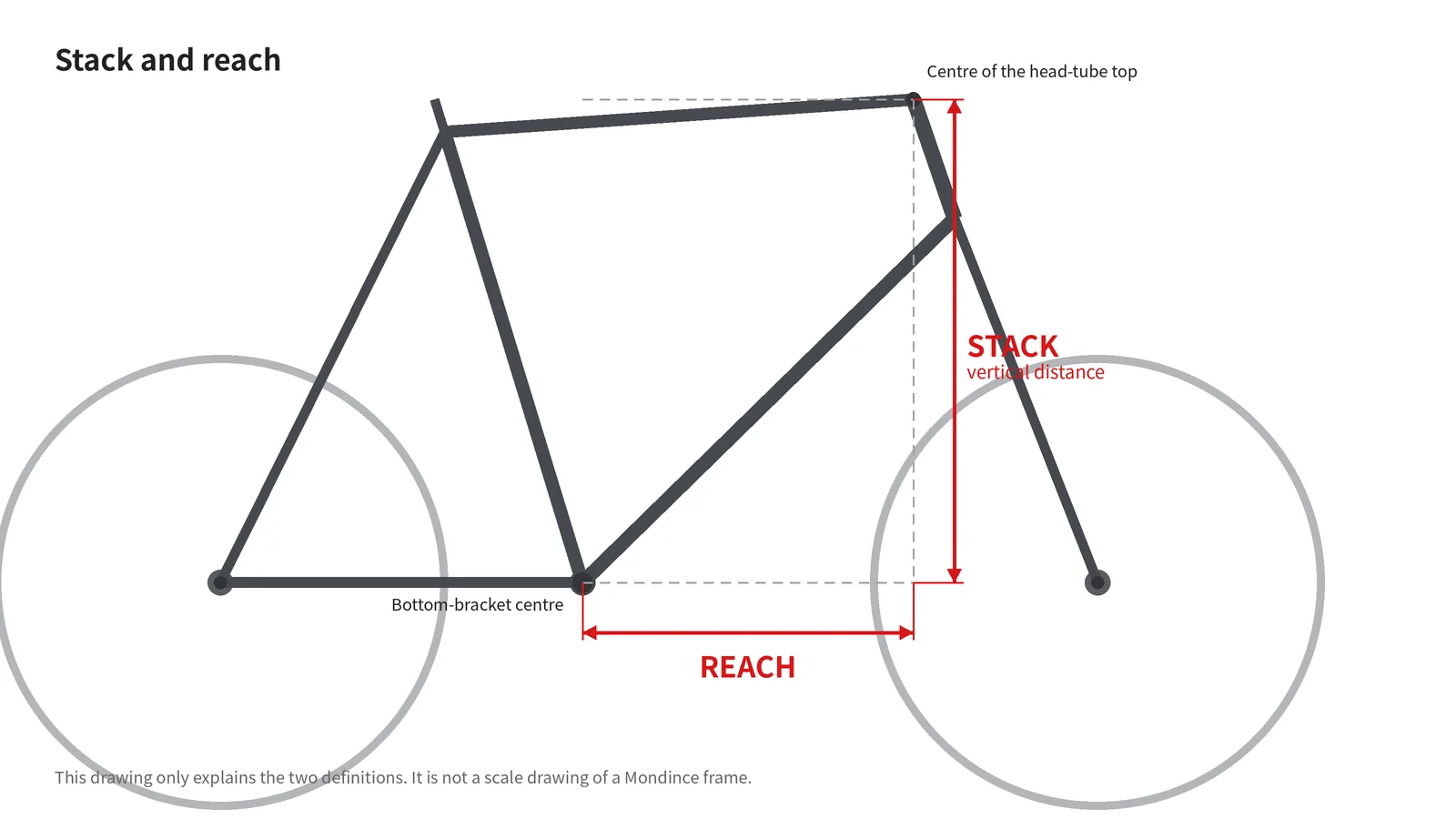
Stack helps you judge how high the bars can start; reach helps you judge the starting length.
- If you want a more relaxed position, you will carry luggage, or you ride for long periods, a shorter reach alone does not mean the bike will fit better.
- Also look at stack, wheelbase, chainstay length, and how you will actually use the bike.
- Where you can, a bike that already fits you is a more reliable reference than the size label.
Source: BikeRadar’s “The ultimate guide to bike geometry and handling” defines stack as the vertical distance from the bottom-bracket centre to the centre of the top of the head tube, and says it sets the lowest handlebar height before you add spacers. Reach is the horizontal distance between the same two points. The article uses mountain bikes as its example, but the definitions themselves are general. It also notes that a bike with a higher stack can feel longer than the reach number suggests, so you should not compare frames by reach alone.
https://www.bikeradar.com/features/the-ultimate-guide-to-bike-geometry-and-handling
When to open the geometry chart, and when to contact us
Once you have a target model and this chart or the calculator has pointed to one or two sizes, open that model’s geometry chart.
Look at these figures first:
- Stack, reach and standover
- Whether the wheelbase and chainstay length suit your intended use
- Whether a seatpost insertion range is published
- Do not order just because the label matches the centimetre size in the table
Send us your measurements instead of guessing between two labels when:
- You sit between two sizes
- You have a bike that fits you well, but the labels do not match
- You have a clear target for handlebar height and reach
- The geometry chart for your target model is missing a figure you need
- You cannot tell whether the seatpost insertion will be enough
When you write to us, include if you can:
- Height (cm) and inseam (cm)
- The target model and the candidate sizes
- A bike that already fits you: brand, model, size, and any stem length, spacer height and saddle height you know
- The handlebar height and reach you want
- Your main use, for example paved roads, gravel, riding with luggage, or touring
This information is for comparing geometry. This chart does not replace an in-person bike fit. If your position is still uncertain, a fitting session can still help.
Next steps
- Use this chart to mark a starting size, then check it once with the Bike Frame Size Calculator. Both results are only a starting point.
- Then compare frames by intended use on the category pages: gravel on Carbon Gravel Bike Frames and Framesets, road on Carbon Road Bike Frames, and mountain bikes on Carbon MTB Frame.
- After you have checked the geometry chart for your target model, if you are still unsure which size to choose, send us your height, inseam, a bike that already fits you, and the target model, and we will help you check.
Check your starting size
Use the Bike Frame Size CalculatorThe result is a starting estimate; confirm it on the model geometry chart.
Summary
Start by measuring your height and inseam, use this chart to mark a starting size, then confirm it on the geometry chart for your target model. Do not order from the size label alone.
- The same “54” or “M” is not interchangeable across brands or models
- Between two sizes, check whether the saddle height and handlebar position you want can be reached
- If the page does not publish a seatpost insertion range, do not assume the saddle can be raised or lowered far enough
- If you want a more relaxed position, will carry luggage, or ride for long periods, do not judge by reach alone
- If you are still unsure after you have chosen, send us your height, inseam and target model and we will help you check.