

32-Inch Gravel Bike Frames: Head-Tube Angle, Seat-Tube Angle, and Whether the Size Will Catch On
A 32-inch gravel bike is not a 700c frame scaled up. Once the bead-seat diameter changes, the head-tube angle, the seat-tube angle and the size range all have to be rearranged.
- Here, 32-inch is a wheel size, not a 32-inch frame size and not a 32 mm tyre.
- In production examples already on sale, there is no single head-tube angle: some touring platforms sit around 67°, some gravel platforms around 70°–71°.
- The larger diameter usually rolls over rough ground more easily and holds speed better, but weight, acceleration, reach for smaller riders, and the parts ecosystem all set limits.
- Mondince’s forthcoming 32-inch frame is the FM32. This article publishes official size-M figures from the geometry drawing; other sizes, clearance, weight and price still wait for the live product page.
What “32-inch” actually means
A 32-inch gravel wheel is a rim with a 686 mm bead-seat diameter. It is not a 32 mm-wide tyre, and it is not a frame size marked in inches.
- Whether a tyre and a rim match depends on bead-seat diameter (BSD), not on the everyday names 32-inch, 29-inch or 700c.
- Sheldon Brown’s rim-sizing table maps the traditional name 32 inch to an ISO bead-seat diameter of 686 mm. On the same table, 700c and 29 inch are both 622 mm, and 650B is 584 mm.
- A common mix-up: the sidewall mark
32-622means a 32 mm tyre on a 700c rim, which is not a 32-inch wheel at all. - Overall diameter only approaches 32 inches once a tyre is fitted. Salsa’s official geometry notes, for example, measure the Fargo 32 on a 32×2.4-inch tyre at 818.5 mm overall.
- An existing 700c gravel frame cannot simply take a 686 mm rim. Chainstay length, fork height, head-tube angle, bottom-bracket height and standover all have to be redesigned around the larger wheel.
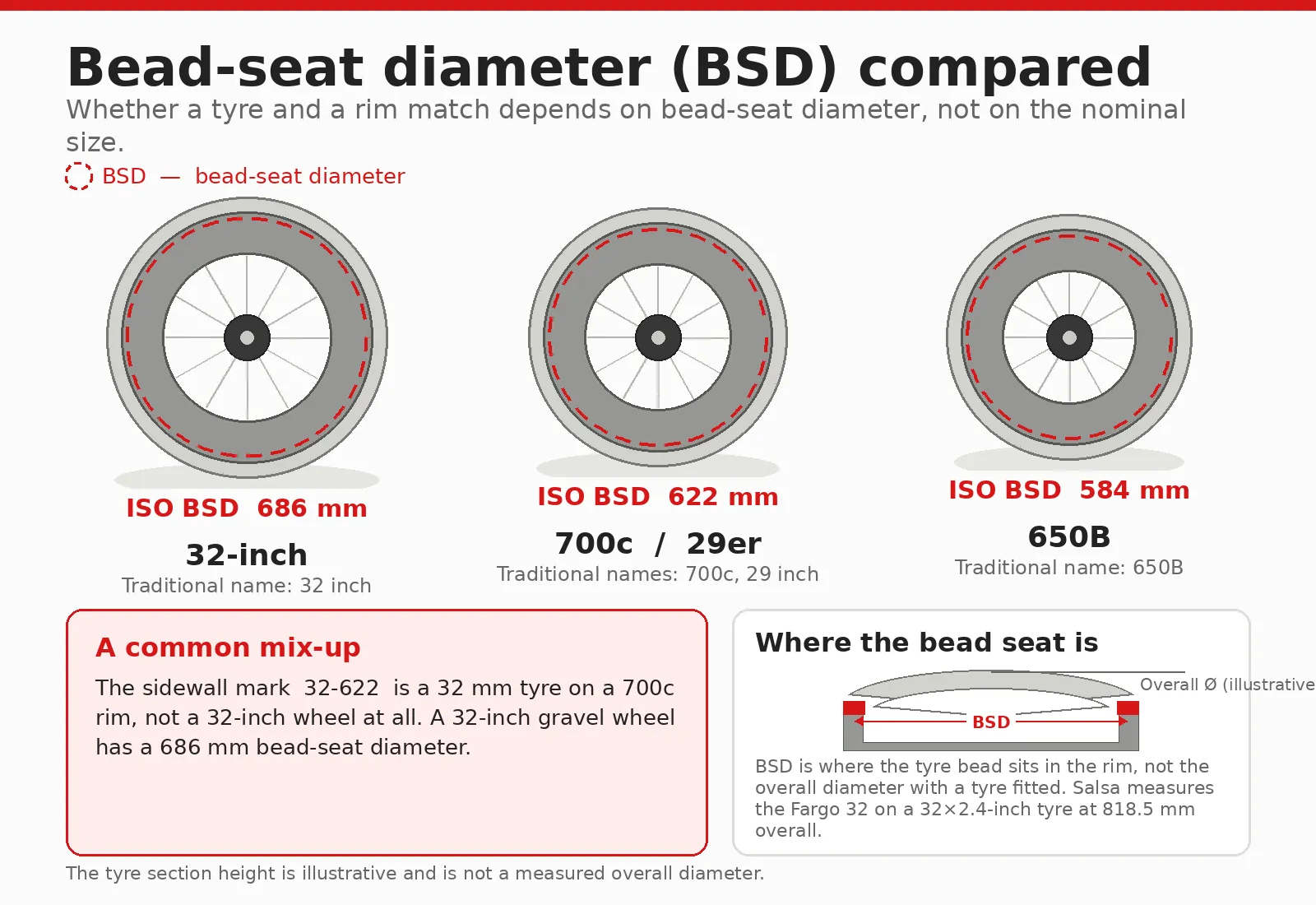
32-622 is a 32 mm tyre on a 700c rim, not a 32-inch wheel.Sources
The bead-seat diameters come from Sheldon Brown’s rim-sizing notes: Measuring Bicycle Rims and Hub Flanges
The difference between ISO 686 and the sidewall mark 32-622 is explained by Willow Bike: 32” (ISO 686) Wheels
Schwalbe’s 32-inch gravel tyre announcement is reported by BIKE: Schwalbe announces 32-inch tyres for gravel bikes
The Fargo 32 measurement standard and overall diameter are on Salsa’s official frameset page: Fargo 32 Steel Frameset
Why an existing 700c frame cannot take a 686 mm rim is covered by Travers: 32-inch wheels: what actually fits
Why the head-tube angle matters more on a 32-inch platform
Once the wheel is larger, the head-tube angle is no longer a number you can copy from a 700c bike. It changes trail, the way the front wheel self-centres at low speed, and the balance between going straight and turning.
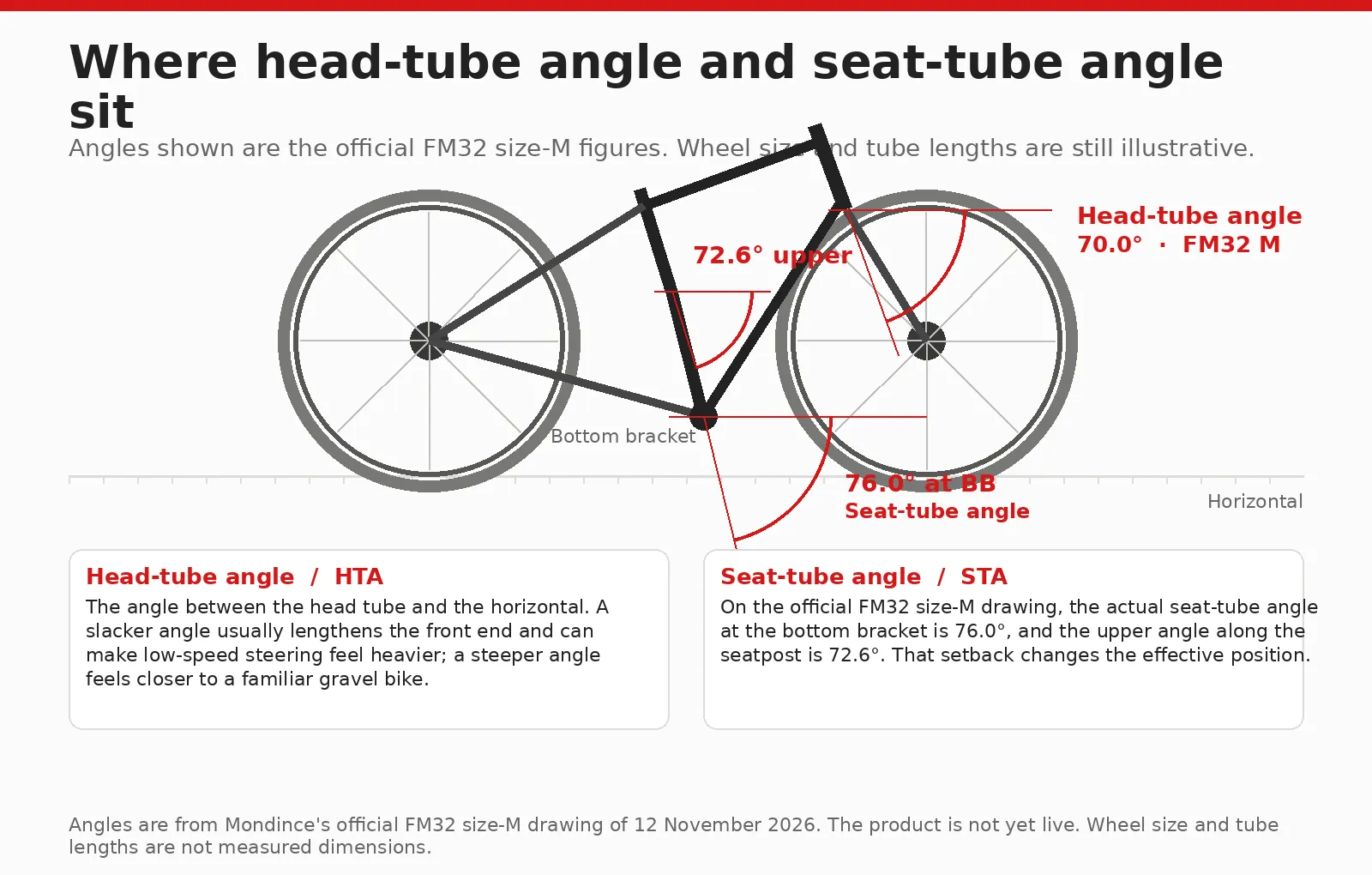
- Published head-tube angles on 32-inch gravel or touring platforms are not close to one another.
- Salsa’s Fargo 32 uses 67.0° in every size. The brand describes it as drop-bar mountain/touring geometry redesigned around a 32-inch wheel, for steering that is more stable and more predictable.
- Singular’s Pterodactyl officially uses a steeper angle of about 71°, to keep steering lively on the larger wheel; BikeRadar’s review table lists 71° in L, XL and XXL.
- Travers’s standard 32-inch gravel geometry is also 71° in every size.
- Avona’s Callis 32 is officially 70° in every size, with 60 mm fork offset and a 438 mm axle-to-crown height — a quicker, more speed-oriented layout.
- Mondince’s forthcoming FM32 has an official size-M head-tube angle of 70.0°. That sits in the 70°–71° gravel group, not in the Fargo 32’s 67° touring geometry.
- As a 700c contrast, the live FM366 aero carbon gravel frameset(700c) has a size-M head-tube angle of 70.5°, only 0.5° steeper than FM32 size M. That shows FM32 is not a 700c layout scaled up, but it also has not been pushed into a very slack touring geometry.
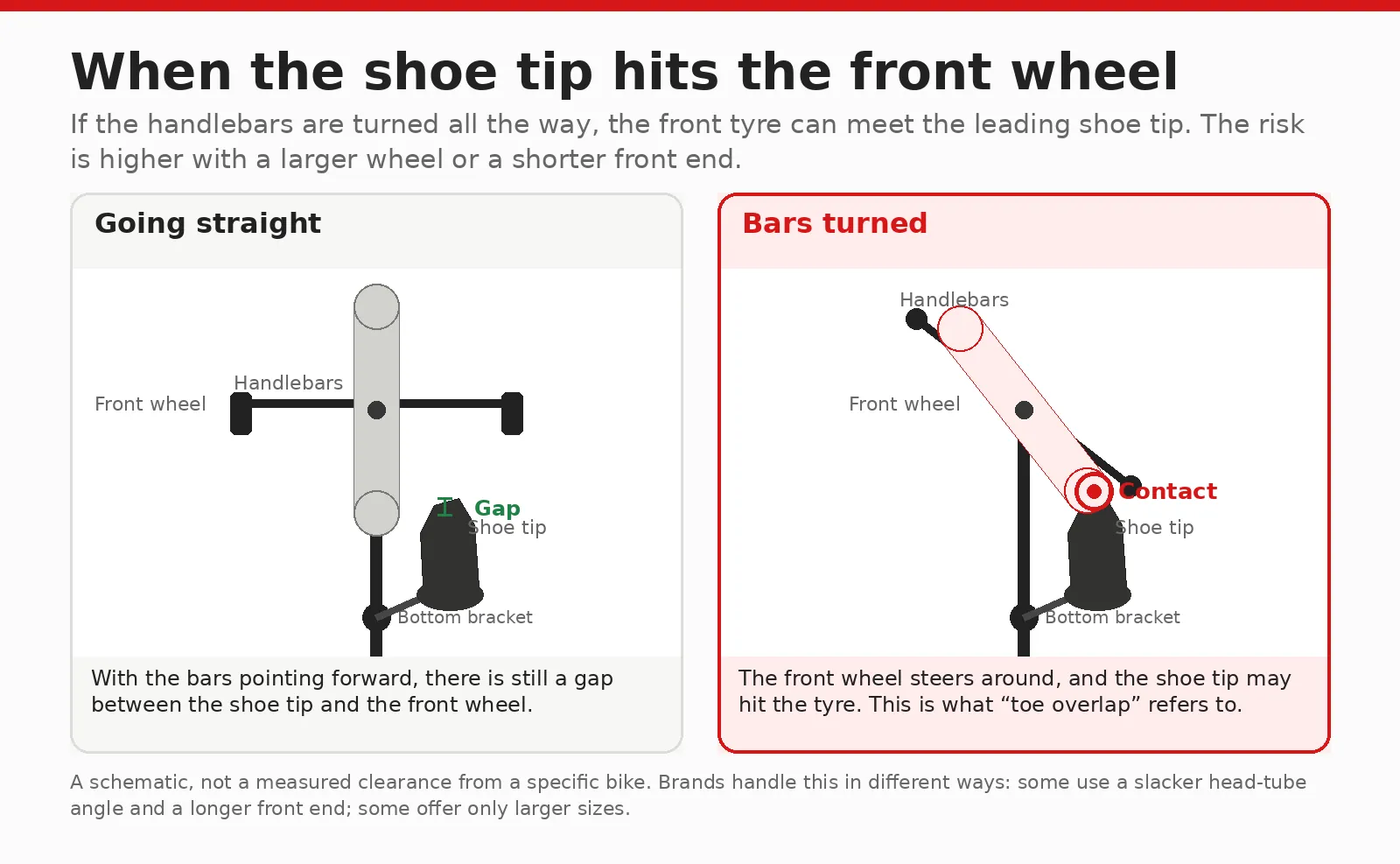
- A slacker head-tube angle usually lengthens the front end and reduces the chance of the shoe tip hitting the front wheel in a tight turn; it can also make low-speed steering feel heavier. A steeper angle can make a big-wheeled bike feel closer to a familiar gravel bike, but fork length and offset have to be calculated with it; you cannot change this angle alone.
- Salsa’s FAQ states that a longer top tube, a shorter stem and the slacker head-tube angle reduce toe overlap. Singular, by contrast, offers only larger sizes, to avoid slow steering and toe overlap.
Sources
Salsa Fargo 32 head-tube angle and platform intent: Fargo 32 Steel Frameset
How a longer top tube, shorter stem and slacker head-tube angle reduce toe overlap: Fargo 32 FAQ
Singular Pterodactyl’s roughly 71° head-tube angle and size range: Pterodactyl
71° in L, XL and XXL: Singular Pterodactyl review (BikeRadar review table)
Travers’s standard 32-inch gravel head-tube angle: 32-inch gravel frame
Avona Callis 32 head-tube angle and fork figures: Callis 32
FM32 size-M head-tube angle: Mondince official geometry drawing, 12 November 2026 (the product is not yet live).
Live FM366 (700c) geometry used for contrast: FM366 aero carbon gravel frameset(700c)
Why the seat-tube angle still matters
Seat-tube angle sets how far the saddle sits ahead of or behind the bottom bracket. That changes effective reach, pedalling position, and how much room is left as the larger rear wheel comes closer to the BB.
- A steeper seat-tube angle moves the saddle forward, so the same reach number does not ride the same way; a slacker angle does the opposite.
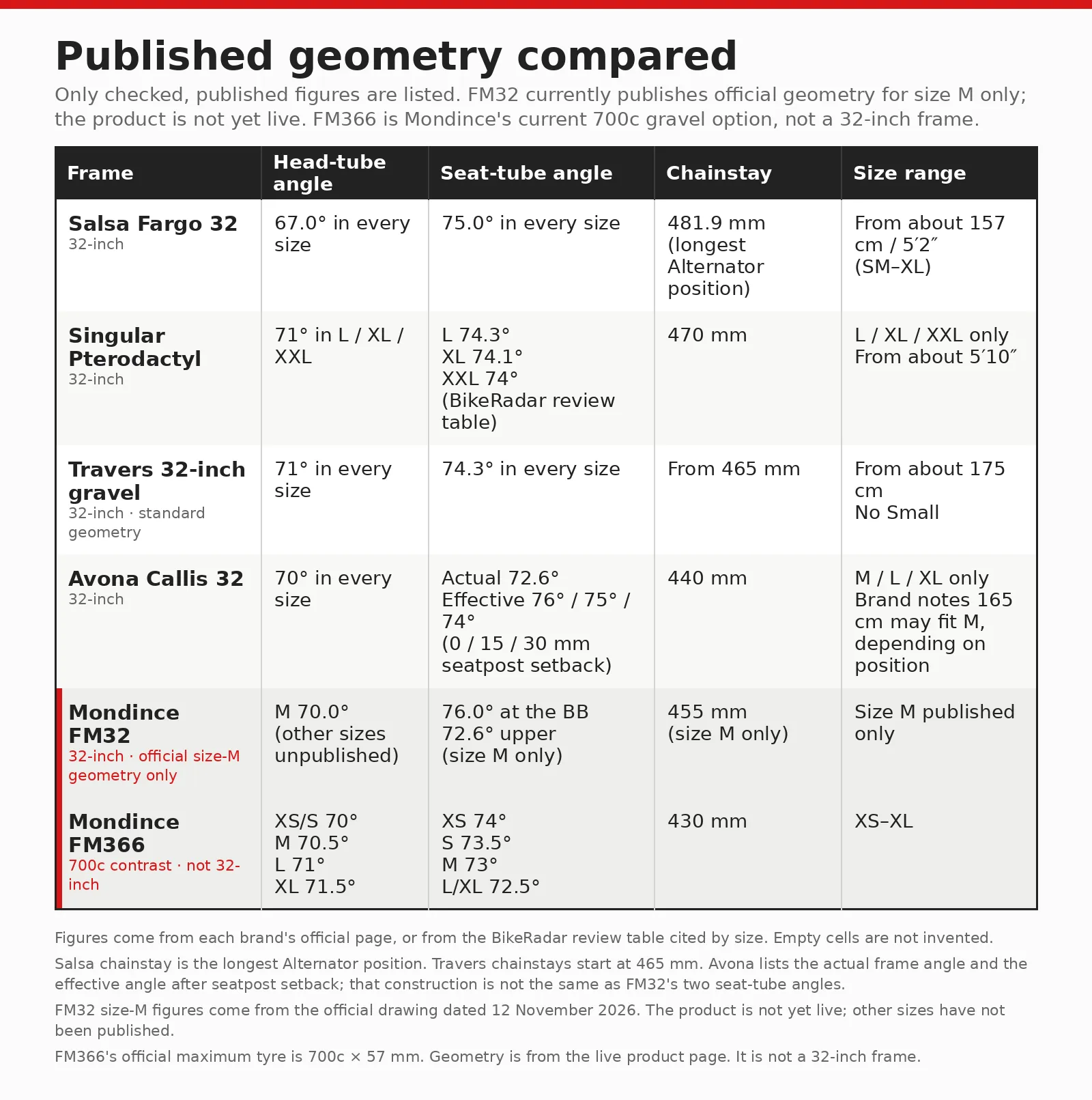
- Salsa’s Fargo 32 uses 75.0° in every size, in line with its touring and load-carrying brief.
- Singular’s Pterodactyl, in BikeRadar’s published table, is 74.3° in L, 74.1° in XL and 74° in XXL.
- Travers’s standard 32-inch gravel geometry is 74.3° in every size.
- Avona’s Callis 32 separates the actual seat-tube angle on the frame from the effective angle once a seatpost is fitted: the actual angle is 72.6°; with 0 / 15 / 30 mm setback posts, the effective angles are 76°, 75° and 74°.
- On Mondince’s official FM32 size-M drawing, the seat tube also has two angles: 76.0° actual at the bottom bracket, and 72.6° along the upper seatpost direction, to show how setback changes the effective position.
- The numbers look close to Avona’s, but the construction is different. Avona publishes an actual frame angle of 72.6° and then gets the effective angles from posts with different setback. The shared appearance of 72.6° and 76° does not make them the same structure.
- For contrast, the live FM366 (700c) size M has a 73° seat-tube angle.
- A 32-inch rear wheel has a larger radius, so the seat tube often has to curve or leave room for the tyre, and the chainstay is longer. FM32 size M uses a 455 mm chainstay, 25 mm longer than the 430 mm chainstay on FM366 size M. Travers notes that the seat tube has to clear the rear tyre, with chainstays starting at 465 mm; Salsa’s Fargo 32 is 481.9 mm at the longest Alternator position; Singular’s table lists 470 mm.
- A larger front wheel also raises the risk of toe overlap. FM32 size M has a 665 mm front centre, longer than the 634 mm on FM366 size M, which helps reduce that risk. Salsa uses a slacker head-tube angle and a longer front end; Singular and Travers simply leave smaller sizes out of the regular range. These are combined decisions about position and wheel path, not something a single seat-tube angle can fix on its own.
Sources
Seat-tube angles and chainstay figures: the official geometry tables and the BikeRadar review table cited above.
Travers on the seat tube clearing the rear tyre, with chainstays from 465 mm: 32-inch wheels: what actually fits
FM32 size-M seat-tube angles, chainstay and front centre: Mondince official geometry drawing, 12 November 2026 (the product is not yet live).
32-inch wheels for gravel: the gains and the costs
The advantage of a 32-inch wheel on rough ground is real, but it is not a free upgrade. The costs are written into reviews and official notes as well.
Benefits
- The approach angle to an obstacle is shallower, so rocks, roots and ruts are less likely to dump your speed all at once. BikeRadar’s Pterodactyl review, and notes from Salsa and BIKE, all treat this as the main reason.
- The larger circumference is more likely to “bridge” a hole than fall into it, which helps hold momentum on long gravel roads.
- The contact patch is often longer; Salsa and BikeRadar both mention better grip in corners and on wet or loose surfaces.
- For taller riders, a larger wheel can put you between the two wheels rather than perched high above a 622 mm rim. Willow makes this point clearly.
- Avona has published its own comparison test: at 35 km/h, with a system weight of 86 kg, it measured the Callis 32 about 11.7 W lower in rolling resistance than its own 700c Callis. That is the brand’s own measurement, not an industry standard, and should be read as one data point.
Costs
- Many 32-inch bikes are not aimed at every height. Singular offers only L/XL/XXL, described as about 5'10" to 6'9"; Travers starts at about 175 cm and has no Small; BikeRadar’s conclusion is simply that you need to be tall enough.
- Some brands are trying to cover shorter riders: Salsa’s Fargo 32 is officially listed from 5'2" (about 157 cm), and a 5'3" engineer in the FAQ felt the Small was rideable; Avona says a 165 cm rider may fit size M in a given position. Neither brand presents a small size as cost-free, and Salsa also notes that standover is the hardest part.
- Rotating mass is higher, so acceleration and tight turns usually take more effort. Willow and BIKE both say so; BikeRadar’s test bike weighed 11.5 kg, heavier than the reviewer’s own 700c gravel bike.
- Ready-made parts are still scarce. Suitable forks, rims, tyres and tubes have to be matched as a set. Travers has noted that 32-inch suspension forks are rare and still relatively heavy; Cycling Weekly reported that Mosaic even had to make its own fork, to control front-end height and leave room so the shoe tip does not hit the front wheel.
- Schwalbe’s retail G-One RS Pro / RX Pro sizes are 50-686 and 55-686, with reported availability in April 2027. Until then, replacement tyres and tubes cannot be thought of in 700c terms.
- A 32-inch rim will not fit an existing 700c frame. Salsa says so directly: the Fargo 32 is designed only around a 32-inch wheel and 50 mm–2.4-inch tyres, and cannot be converted to another wheel size.
Sources
Rolling over obstacles, test-bike weight and the size limit: Singular Pterodactyl review
Salsa on height coverage and standover: Fargo 32 FAQ
Schwalbe retail tyre sizes and availability: BIKE, Schwalbe announces 32-inch tyres for gravel bikes
The shortage of dedicated forks, and Mosaic having to make its own: Cycling Weekly, Off-road is buzzing over 32-inch wheels
Rotating mass and taller riders’ position: Willow Bike, 32” (ISO 686) Wheels
32-inch suspension forks being scarce and relatively heavy: Travers, 32-inch wheels: what actually fits
Avona’s own rolling-resistance comparison: Callis 32
Will the size catch on?
32-inch gravel wheels have moved from prototypes to limited production, but the parts ecosystem and the size coverage are still incomplete. That is not yet a basis for calling the size mainstream.
- Production or small-batch examples already for sale include the Salsa Fargo 32 steel frameset (the official page showed stock today), the Singular Pterodactyl, and the Avona Callis 32. Travers offers a made-to-measure 32-inch titanium gravel frame.
- At the 2026 Unbound Gravel XL, Robin Gemperle won on a Scott 32-inch prototype; Leon Kaiser also won a UCI Gravel World Series race in Girona on a 32-inch bike. BIKE’s view is that this shows the format can handle high-level racing, but it does not replace the question of market acceptance.
- The tyre supply is still being filled in. Schwalbe announced in September 2026 that retail tyres were expected in shops in April 2027; Cycling Weekly, at the August 2026 MADE show, saw dedicated forks, carbon rims, tyre options and TPU tubes, and wrote that the ecosystem was “starting to look like a thing,” while also noting that many parts were still missing.
- Sizing is another hurdle. Some bikes only start at about 175 cm or 5'10"; others take a Small down to about 157 cm. If smaller sizes remain hard to get right, 32-inch will look more like a format for taller riders and long, rough routes than a full replacement for 700c.
- Road racing is basically closed: Cycling Weekly notes that UCI rules cap overall wheel diameter at 700 mm, and a 686 mm bead seat plus a usable tyre would exceed that. Gravel and touring are not bound by that road rule, which is why any spread will happen first off the road.
- The more cautious view is that 32-inch will keep adding options for taller riders, long gravel events and routes that reward rolling over obstacles. Whether it becomes the new default gravel wheel size still depends on a stable supply of tyres, wheels and forks, and on whether small and medium sizes genuinely fit.
Mondince FM32, and how it compares with a current 700c frame
FM32 is Mondince’s forthcoming 32-inch gravel frame. The geometry has been rearranged around the larger wheel, rather than scaling up an existing 700c frame.
- The product is not yet live. Only official size-M geometry is published below, from the official drawing dated 12 November 2026.
- Other sizes, wheelbase, trail, tyre clearance, weight and price are not on the drawing, so they are not listed here. Those figures still wait for the live product page.
- Compared with size M on the live FM366 aero carbon gravel frameset(700c), the layout is clearly made for a 32-inch wheel.
| Item | FM32 M | FM366 M (700c) |
|---|---|---|
| Head-tube angle | 70.0° | 70.5° |
| Seat-tube angle | 72.6° upper / 76.0° at the BB | 73° |
| Stack | 598.9 mm | 586 mm |
| Reach | 415 mm | 391 mm |
| Effective top tube | 564.3 mm | 570 mm |
| Seat-tube length | 490 mm | 520 mm |
| Head-tube length | 95 mm | 150 mm |
| Chainstay | 455 mm | 430 mm |
| Front centre | 665 mm | 634 mm |
| BB drop | 115 mm | 80 mm |
| Fork length | 445 mm | 405 mm |
| Fork offset | 60 mm | 55 mm |
- The head-tube angle is only 0.5° slacker than FM366 size M, and stays in the 70°–71° gravel group.
- BB drop is 115 mm, close to the 112 mm on Avona’s Callis 32. The point is to keep the front end from rising too far with the larger wheel, so stack is only about 13 mm higher than FM366 size M.
- Reach is 415 mm, already longer than the 407 mm on FM366 XL. A size-M letter on FM32 is not the same sitting position as a 700c size M, and the letters should not be swapped directly.
- The chainstay is lengthened to 455 mm and the front centre to 665 mm, which helps clear the larger wheel and reduce toe overlap.
- The seat tube is shortened to 490 mm and the head tube to 95 mm, which helps standover on a big-wheeled bike.
- FM366 is here only as a 700c contrast. It is a live aero gravel frameset whose official maximum tyre is 700c × 57 mm, not a 32-inch frame.
- Before choosing 32-inch or 700c, check your height and inseam, then the geometry table of the specific model. The gravel bike size chart and the bike frame size calculator are a useful starting point.
- To browse the gravel frames Mondince already has live, compare use, clearance and geometry on Carbon Gravel Bike Frames and Framesets.
Sources
FM32 size-M figures: Mondince official geometry drawing, 12 November 2026 (the product is not yet live).
Live FM366 (700c) geometry used for contrast: FM366 aero carbon gravel frameset(700c)
Next steps
- Carbon Gravel Bike Frames and Framesets
- FM366 aero carbon gravel frameset(700c)
- Gravel bike size chart
- Bike frame size calculator
In short
A 32-inch gravel frame is worth a close look, but only after you separate a change in rim size from tyre width, and from any idea that there is one standard angle you can reuse.
- The 686 mm bead-seat diameter is larger than the 622 mm of 700c / 29er, so the frame and fork have to be designed around that diameter.
- Published head-tube angles can sit as slack as about 67°, or around 70°–71°; seat-tube angles also vary with the bike’s brief, and seatpost setback can change the effective angle.
- The main attraction is rolling over rough ground and holding speed; the limits come from height coverage, weight, and a still-thin supply of wheels, tyres and forks.
- Production examples already exist, and prototypes have race results, but that is not enough to call the size mainstream.
- Mondince’s forthcoming FM32 has an official size-M head-tube angle of 70.0°, an actual seat-tube angle of 76.0° at the bottom bracket, and 72.6° along the upper seatpost direction. The product is not yet live; other sizes, clearance, weight and price still wait for the product page.
- The live FM366 remains a 700c option, useful as a contrast and not as a 32-inch product. In size M, FM32 has a longer reach, so the size letters should not be swapped directly.