
Bikepacking Frames – The Complete Guide to Adventure-Ready Carbon Frames
A great bikepacking frame is the foundation of every unforgettable multi‑day adventure. Unlike a standard road or gravel bike, a purpose‑built bikepacking frame is engineered to carry gear, handle rough terrain, and keep you comfortable for hours on end — without compromising handling or durability. This guide covers everything you need to know: relaxed geometry, tire clearance, mounting points, internal storage, frame materials, and how to choose the right platform for your next expedition. Whether you're planning a weekend overnighter or a months‑long transcontinental ride, this resource will help you build the perfect bikepacking rig.
⚡ Quick Navigation
➡️ What Makes a Bikepacking Frame Different?
➡️ Bikepacking Geometry – Stability Over Speed
➡️ Tire Clearance – Wide Tires for Comfort and Grip
➡️ Mounting Points – 3‑Boss, Fork Mounts, and Rack Options
➡️ Internal Downtube Storage – The Game‑Changer
➡️ Frame Materials – Carbon vs Steel vs Titanium vs Aluminum
➡️ Mondince Bikepacking Frames – Comparison Guide
➡️ Bikepacking Setup Guide – Frame Bags, Saddle Packs, Handlebar Rolls
➡️ FAQ
What Makes a Bikepacking Frame Different?
At its core, bikepacking is a multi‑day cycling adventure that carries gear in frame‑mounted bags rather than heavy pannier racks. Unlike traditional cycle touring, bikepacking prioritizes lightweight gear, minimalist packing, and access to technical terrain — singletrack, gravel roads, and remote wilderness areas that would be difficult or impossible to navigate with traditional racks and panniers. Bikepacking frames are specifically designed to support this philosophy.
While many modern gravel bikes can handle light bikepacking duty, a frame built from the ground up for bikepacking includes several distinctive features:
- Relaxed geometry – Longer wheelbase, slacker head tube angle, and taller stack for stability when loaded.
- Ample tire clearance – Room for 45‑50mm gravel tires or even 2.1‑2.2″ MTB tires for rough terrain.
- Numerous mounting points – 3‑boss cargo cage mounts on fork legs, under downtube, top tube, and seat tube.
- Large main triangle – Tall, square frame triangle maximizes frame bag capacity.
- Internal downtube storage (modern designs) – Built‑in compartments for tools, tubes, and essentials.
- 1.3 Times ISO 4210 certified durability – Frames tested to handle the stresses of loaded touring.
In short: a dedicated bikepacking frame is built for stability, durability, and cargo capacity — everything you need to venture far from civilization with confidence.
Bikepacking Geometry – Stability Over Speed
The single most important design decision for a bikepacking frame is geometry. Unlike a road or race gravel bike that prioritizes agility and aerodynamics, a bikepacking frame (like the Kona Unity or the Salsa Cutthroat) prioritizes stability — especially when the bike is fully loaded with bags and gear. Here are the key geometry numbers that matter.
Longer Wheelbase
A longer wheelbase (typically 1030‑1080mm in medium sizes) provides a more planted, confidence‑inspiring feel on rough terrain at speed. A shorter wheelbase can feel twitchy when carrying front or rear loads; a longer wheelbase dampens steering input and keeps the bike tracking straight even on loose descents. Modern bikepacking frames also use slacker head tube angles (68‑71°) which increase high‑speed stability and make the bike less prone to over‑steering when loaded.
Higher Stack, Shorter Reach
A taller head tube (higher stack) and shorter reach create a more upright riding position. This reduces strain on the lower back, neck, and shoulders — critical for 8‑10 hour days in the saddle. An aggressive, stretched‑out position may be faster for an hour, but it becomes punishing after multiple days of loaded riding. For bikepacking, comfort is the ultimate performance metric.
Lower Bottom Bracket (BB Drop)
A lower bottom bracket (70‑80mm drop) lowers the rider’s center of gravity, improving cornering stability and making the bike feel more planted when the frame is carrying significant weight. This is especially noticeable when descending loose gravel or singletrack with a loaded frame bag.
Steeper Seat Tube Angle
A steeper seat tube angle (74‑76°) positions the rider more centrally over the bottom bracket. This improves climbing traction — especially important when the bike is loaded with gear on the rear. It also helps maintain an efficient pedaling position even when the saddle is set back further for comfort.
Large Frame Triangle
A tall, square frame triangle (achieved with a less‑sloped top tube and longer head tube) maximizes frame bag capacity. This allows you to use a full‑length or half‑length frame bag without interference. More frame bag space means more gear carried low and centered — the best place for weight distribution. This is a deliberate design choice seen on frames like the Kona Unity, which features a cavernous front triangle that can swallow a seriously large frame pack. Large triangle space is often sacrificed on modern MTB frames due to long‑travel suspension and dropper posts, but dedicated bikepacking frames prioritize it.
Tire Clearance – Wide Tires for Comfort and Grip
Tire clearance is arguably the most practical specification for a bikepacking frame. More clearance means more options, and more options mean you can match your tires to the terrain you‘ll face.
Why wide tires matter for bikepacking: The ability to run wider tires (45‑50mm gravel tires or 2.1‑2.2″ MTB tires) transforms your bike’s capability.
- Comfort – Wider tires at lower pressures absorb small bumps and vibrations more effectively than narrow tires, reducing hand, arm, and back fatigue over long days on rough terrain.
- Traction – A larger contact patch improves grip on loose gravel, sand, mud, and wet roots. You‘ll climb better and corner with more confidence.
- Puncture resistance – Wider tires can be run tubeless at lower pressures, which allows the sealant to plug small punctures more effectively than narrow tires.
- Terrain flexibility – With 50mm of clearance, you can choose fast‑rolling 42mm tires for a mixed‑surface route or aggressive 2.1″ knobbies for a remote singletrack adventure.
- 650b compatibility – Many modern frames are designed to handle both 700c and 650b wheels, offering even more tire selection. A 650b wheel with a 2.1″ tire has roughly the same outer diameter as a 700c wheel with a 28mm road tire – but triple the air volume and comfort.
What clearance do you need?
- Up to 45mm – Sufficient for well‑maintained gravel roads, fire roads, and mixed pavement. This is the minimum for serious bikepacking.
- 45‑50mm – The sweet spot for most bikepacking adventures. Handles rough gravel, loose terrain, and even moderate singletrack with confidence.
- 50mm+ (2.1‑2.2″) – For riders who plan to tackle technical singletrack, remote mountain passes, or extended off‑road sections. This clearance allows you to run true mountain bike tires without giving up drop‑bar ergonomics.
Mounting Points – 3‑Boss, Fork Mounts, and Rack Options
A bikepacking frame is defined by its mounting points. Unlike a standard road bike, a properly equipped bikepacking frame has attachment points for cargo cages, bottle cages, top tube bags, and sometimes racks.
3‑Boss Mounts (Cargo Cages)
The 3‑boss mounting system is the industry standard for attaching cargo cages to fork legs, under the downtube, and sometimes along the top tube. This three‑hole pattern provides a secure, vibration‑resistant platform for carrying water bottles, dry bags, or specialized cargo cages (like the Salsa Anything Cage or Blackburn Outpost). Key locations to look for on a bikepacking frame:
- Fork legs (each side) – Two or three boss mounts per fork leg allow you to attach cargo cages or bottle cages. This is essential for carrying bulky but lightweight gear like sleeping bags, tents, or extra water. Bikepacking frames with three mounts per leg give you the most flexibility to position cages at different heights.
- Downtube (underside) – A third bottle cage mount under the downtube provides additional water capacity or a location for a tool keg. This placement keeps weight low and centered.
- Top tube – Bolt‑on mounts for a top tube bag let you access snacks, phone, or maps without stopping.
- Seat tube – Mounts for a pump or additional bottle cage.
- Rear rack mounts – Traditional rack mounts (near the dropouts and seat stays) allow you to install a rear rack for panniers or a rackless dry bag system. Many bikepackers prefer rackless systems, but having the option is valuable.
Internal Downtube Storage (The Modern Standard)
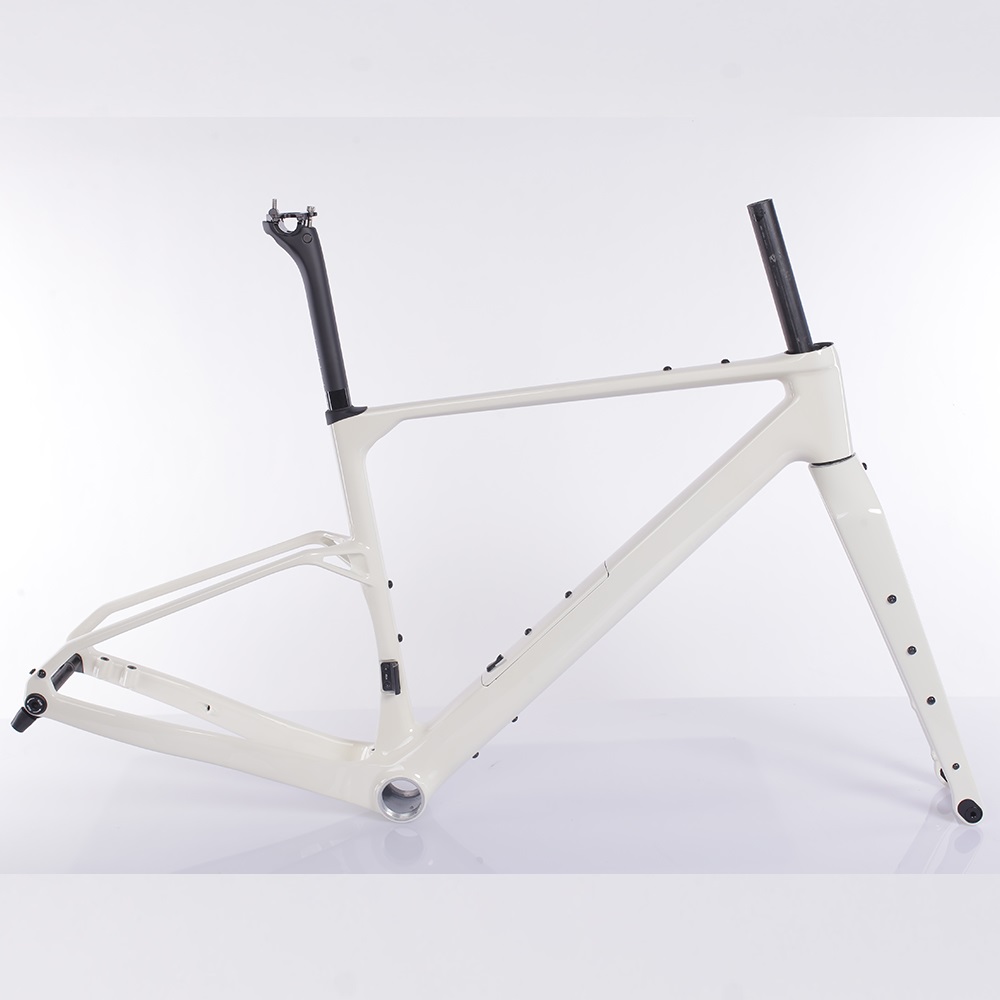
Internal downtube storage is one of the most innovative recent developments in bikepacking frame design. Integrated storage compartments built into the frame’s downtube — accessed via a weather‑resistant hatch — let you store tools, tubes, snacks, or even a lightweight jacket without needing external bags. This keeps weight low and centered (the best place for it), improves aerodynamics, and protects your essentials from the elements. It’s a game‑changer for minimalist, lightweight bikepacking setups. Mondince pioneered this feature on gravel frames and has refined it across the FM316 and FM326 models.
Frame Materials – Carbon vs Steel vs Titanium vs Aluminum
Each frame material has distinct advantages for bikepacking. The choice depends on your priorities: weight, durability, cost, and ride feel.
| Material | Weight | Comfort | Durability | Cost | Best For |
|---|---|---|---|---|---|
| Carbon Fiber | Very light (900‑1200g) | Excellent – tunable compliance zones | Excellent when designed for impact; no fatigue limit | Moderate‑High | Performance bikepacking, lightweight builds, climbing, mixed terrain |
| Steel | Heavy (1800‑2500g) | Excellent – natural “springy” ride | Very good; repairable in remote areas | Moderate | Remote expeditions, rugged terrain, riders who prioritize repairability |
| Titanium | Moderate (1400‑1800g) | Excellent – combines steel compliance with carbon weight | Excellent – corrosion‑proof, near‑indefinite lifespan | High | Lifetime ownership, premium custom builds |
| Aluminum | Moderate (1400‑1800g) | Moderate – can transmit road chatter | Good; finite fatigue life (10‑15 years) | Low | Budget builds, casual bikepacking, commuter conversions |
Carbon fiber is increasingly popular among bikepackers who prioritize weight and performance. Modern bikepacking‑specific carbon frames are engineered with durability‑focused layups, using Toray T800 and T1000 carbon in high‑stress zones to resist impacts. Carbon’s vibration damping properties significantly reduce fatigue on mixed terrain, and its tunable compliance zones allow engineers to create frames that are stiff under the bottom bracket (efficient climbing) but compliant through the rear triangle (comfort). For riders who want a lightweight, high‑performance bikepacking rig that climbs efficiently and feels responsive even when loaded, carbon is the best choice.
Steel remains a classic bikepacking choice for its legendary durability and repairability. A steel frame can be welded almost anywhere in the world with basic equipment — a genuine advantage for remote expeditions. Steel also offers a natural “springy” ride quality that absorbs trail chatter well. The trade‑off is weight. A steel bikepacking frame is typically 1.5‑2.5kg, significantly heavier than carbon or titanium. For riders who prioritize expedition‑ready toughness over weight savings, steel is still highly relevant.
Titanium offers a compelling combination: the compliance and fatigue resistance of steel with the corrosion‑proof, lightweight characteristics of carbon. Titanium frames are exceptionally durable — essentially indefinite lifespan — and don‘t require paint, which saves weight and eliminates paint chips from bag strap abrasion. The drawbacks are high cost (titanium frames are the most expensive option) and limited repairability in remote areas. For serious bikepackers who ride often and want a “forever frame,” titanium is an aspirational choice.
Aluminum is the most affordable option for entry‑level bikepacking builds. Modern aluminum frames are hydroformed into sophisticated shapes and can be very light. However, aluminum transfers more road vibration than other materials, which can lead to hand and arm fatigue on washboard roads or chunky gravel. Aluminum also has a finite fatigue life — typically 10‑15 years for a well‑ridden frame — while carbon, steel, and titanium have indefinite lifespans when properly maintained. For bikepackers on a strict budget, aluminum is a practical starting point.
Mondince Bikepacking Frames – Comparison Guide
Mondince offers a complete lineup of premium carbon bikepacking frames, each optimized for different types of adventurers — from lightweight racers to self‑supported expedition riders. All frames feature Toray carbon (T700/T800/T1000), fully internal cable routing, UDH hangers, T47 bottom brackets (or BB92 on select models), and are tested to 1.3 Times ISO 4210 standards. Below is the full range suitable for bikepacking.
| Model | Frame Weight | Tire Clearance | Storage / Mounts | Key Specs | Best For |
|---|---|---|---|---|---|
| FM326 | ~1180g | 700x50mm / 650Bx2.1″ | 1.2L downtube storage + 8 mounting points | T47, UDH, 27.2 seatpost, progressive geo | Multi‑day expeditions, remote terrain, bikepacking with full gear |
| FM296 | ~1050g | 45mm | Multiple cage mounts | T800/T1000, 27.2 seatpost, endurance geometry | Mixed terrain, endurance bikepacking, all‑day comfort |
| FM316 | ~1150g | 50mm / 57mm (front) | 0.8L downtube storage + 6 mounting points | Aero design, T47, UDH, flip‑chip fork | Weekend overnighter, fast gravel, limited kit |
| FM306 | ~1120g | 48mm | Flip‑chip adjustable offset | T800, optional BSA BB, progressive geometry | Light bikepacking, fast gravel, adjustable handling |
| FM286 | ~1080g | 42mm | Multiple mounting points, T47, UDH | Lightweight all‑road, road‑plus geometry, T47 BB | Light bikepacking, mixed pavement, credit card touring |
| FM266 | ~1140g | 45mm | Three cage mounts, 27.2 seatpost | BSA threaded BB, internal routing, endurance geo | Budget bikepacking, all‑road adventure, commuter conversion |
| FM218 / FM228 | ~950‑1050g | 27.5"x3.0" / 29"x2.4" | Multiple mounting points | Carbon hardtail MTB, Boost 148, BB92 or T47 | Off‑road bikepacking, singletrack, rugged terrain |
FM326 – The Expedition‑Ready Platform
The FM326 is Mondince's ultimate bikepacking frame. Featuring 1.2L internal downtube storage — large enough for a full tool kit plus spare tube — and eight mounting points (three per fork leg, top tube, seat tube, under downtube), this frame is designed for self‑supported multi‑day expeditions. The progressive geometry (longer wheelbase, slacker head angle) remains stable with front and rear loads, and the 27.2mm round seatpost adds compliance over rough terrain. Max tire clearance is 700x50mm (or 650Bx2.1″), enough for aggressive gravel or light singletrack. At 1180g, it‘s heavier than pure race frames but engineered for durability.
FM316 – The Weekend Warrior
The FM316 offers 0.8L internal storage and six mounting points, balancing cargo capacity with lightweight performance (1150g). The aero‑optimized tube shapes don't sacrifice mounting versatility, and the flip‑chip fork lets you adjust steering feel from 45mm to 50mm offset. With 700x57mm front tire clearance (50mm rear), the FM316 can handle surprisingly rugged terrain for a frame that still feels fast on pavement sections. Ideal for weekend overtighters, fastpacking, and all‑day gravel adventures where you want to carry essentials without weighing down the bike.
FM296 – The All‑Day Endurance Platform
The FM296 strikes an ideal balance for riders who want a lightweight bikepacking frame without sacrificing comfort. At 1050g, with 45mm tire clearance and compliance‑tuned seat stays, it‘s light enough to climb efficiently yet durable enough for technical sections. Multiple mounting points (including fork cage mounts on request) allow for light to moderate bikepacking setups. This is the frame for riders who prioritize all‑day comfort over massive cargo capacity — think hut‑to‑hut trips or credit card touring with the occasional overnight.
FM306 – The Adjustable All‑Rounder
The FM306 features a unique flip‑chip adjustable fork, allowing you to switch between 45mm and 50mm offset to fine-tune steering feel based on terrain and load. This versatility is valuable for bikepacking — a more relaxed offset (50mm) for stability when the bike is loaded, a quicker offset (45mm) for responsive handling when riding unloaded. At 1120g, with 48mm tire clearance and optional BSA bottom bracket, it‘s a flexible all‑rounder for riders who want one bike to handle everything from fast group rides to loaded overnighters.
FM286 / FM266 – Lightweight Entry and Road‑Plus Options
For bikepackers on a budget or those who ride mostly pavement with occasional gravel, the FM286 (1080g, 42mm clearance) and FM266 (1140g, 45mm clearance) offer lightweight carbon performance at accessible price points. Both feature 27.2mm round seatposts for compliance, threaded bottom brackets (T47 on FM286, BSA on FM266), and multiple bottle mounts. While not designed for heavy expedition loads, these frames are perfect for lightweight bikepacking, credit card touring, and commuting. The FM286 features T47 bottom bracket and UDH hanger for modern standards; the FM266 offers a classic BSA threaded BB for maximum serviceability.
FM218 / FM228 – Hardtail MTB for Off‑Road Bikepacking
For riders who plan to spend significant time on singletrack, remote mountain passes, or rugged off‑road terrain, Mondince's carbon hardtail MTB frames (FM218, 950‑1050g; FM228, ~880g) are excellent bikepacking platforms. With Boost 148 spacing, clearance for 27.5x3.0″ tires, and multiple mounting points, these frames handle heavy loads and rugged trails with confidence. The modern geometry (slacker head angle, steeper seat tube) provides stability on descents while maintaining climbing efficiency. Ideal for off‑road expeditions where drop‑bar comfort isn’t sufficient.
Internal Storage Capacity Comparison
| Storage Volume | What Fits | Example Frame |
|---|---|---|
| 0.8L | Multi‑tool, tire levers, CO2 inflator, spare tube (700x45c), energy gels | FM316 |
| 1.2L | Full tool kit, spare tube, pump, lightweight jacket, snacks, first aid kit | FM326 |
Bikepacking Setup Guide – Frame Bags, Saddle Packs, and Handlebar Rolls
A proper bikepacking setup balances gear across the bike for optimal handling. The goal is to keep weight low and centered, with lighter items at the extremes. Here is the standard bag configuration for most bikepacking trips.
Frame Bag (Main Triangle)
Carries the heaviest items (food, stove, fuel, repair kit, electronics). A full‑length frame bag is ideal for long trips, while a half‑frame bag leaves room for bottle cages. Mondince frames with tall, square main triangles maximize frame bag space. The FM326 and FM316 feature large front triangles specifically designed for this purpose. Use a custom‑fit frame bag whenever possible — universal bags leave wasted space and can flap in the wind.
Saddle (Seat) Pack
Carries bulky but lightweight items: sleeping bag, sleep clothes, pillow. The key is to keep weight minimal behind the rear axle – a heavy saddle pack causes the bike to wag under power on climbs. Use a harness + dry bag system rather than a pre‑shaped saddle pack for more flexible volume and better stability. A dropper‑post‑compatible saddle bag is worth considering if you plan to ride technical descents.
Handlebar Roll
Carries tent, sleeping pad, and extra clothing. Keep the roll as tight as possible, no wider than the handlebar drops. Use a harness + dry bag for maximum volume flexibility. Gravel bikes with wide flared drop bars can accommodate larger rolls without interfering with hand positions on the bar tops.
Fork Cargo Cages
Attach dry bags or water bottles to the fork legs (left and right). Ideal for bulky but lightweight items like sleeping bags, tents, or water containers. Position cages as low as possible to keep weight low. Two or three‑boss mounts per fork leg give you the most flexibility. The FM326 features three‑boss mounts on each fork leg, allowing you to position cages at any height.
Top Tube Bag
Hold items you need during the day: phone, snacks, map, sunglasses. A bolt‑on top tube bag is more secure than strap‑on versions. This is one of the most frequently used bags on any bikepacking setup.
Cockpit Configuration for Bikepacking
- Drop bars (gravel / adventure drop bars) – Aero drop bars are often rated for moderate front loads, but integrated systems restrict bag attachment. A traditional stem and bar combination uses spacers to adjust stack height and accepts most aftermarket harness systems.
- Flat bars – Provide more mounting space for handlebar rolls and accessory lights. Flat bars are often preferred for technical off‑road bikepacking due to increased leverage and control.
Cockpit Mounting Options
- Handlebar roll harness – Most common solution for carrying tent or sleeping bag. Works with both drop bars and flat bars.
- Bar extender (K‑Edge style) – Mounts to the stem faceplate or top cap, providing a platform for GPS units and lights without interfering with the main handlebar roll.
- Top tube mounts – Bolt‑on or strap‑on top tube bags keep snacks and phone accessible.
Mondince Testing Standards – 1.3 Times ISO 4210 for Durability
When you‘re days from the nearest town, frame failure is not an option. That‘s why every Mondince bikepacking frame is independently tested to 1.3 Times ISO 4210 standards — exceeding the industry baseline by 30%.
ISO 4210 is the global safety standard for bicycles, covering impact tests (simulating rock strikes or crash forces), fatigue tests (100,000+ stress cycles to simulate years of riding), and rigidness tests (ensuring the frame doesn’t flex excessively under pedaling loads). Baseline compliance is required for any bicycle sold in regulated markets. Mondince goes further — testing all carbon frames at 1.3 times the standard load requirement.
What does “1.3 Times” mean for bikepacking? If you weigh 80kg and add 15‑20kg of gear (total 100kg), you‘re riding a frame validated to handle stresses equivalent to a 130kg load under extreme conditions — 30% above your actual loaded weight. The bottom bracket won‘t crack under pedaling load. The chainstays won‘t delaminate from impact on a rocky descent. The head tube won‘t develop fatigue cracks after months of washboard rattle. For remote expeditions where replacement isn’t an option, this extra safety margin matters.
Third‑party test reports are available upon request for wholesale customers and OEM partners.
Frequently Asked Questions About Bikepacking Frames
What is the best frame material for bikepacking?
What tire clearance should I look for in a bikepacking frame?
Does internal downtube storage really make a difference?
How important are fork mounting points for bikepacking?
What does 1.3 Times ISO 4210 mean for bikepacking safety?
What is the difference between bikepacking and traditional touring?
Ready to Build Your Bikepacking Dream Machine?
Whether you‘re planning a weekend overnighter on local gravel roads or a months‑long expedition across remote mountain ranges, Mondince Cycle has a carbon bikepacking frame that fits your adventure needs. Every frame is crafted from premium Toray carbon, tested to 1.3 Times ISO 4210 standards, and available with complete customization — from Pantone color matching to full custom geometry.
👉 Explore all carbon frames →
👉 Request a quote or custom geometry →
Related Articles
Best Gravel Frame with Internal Storage for Bikepacking
Why Internal Storage Matters for Bikepacking Traditional bikepacking setups require frame bags, top tube bags, and saddle packs — all of which ...
No articles available for this topic yet.