
Knowing your correct road bike size is the most important step before buying. A bike that fits properly feels natural, efficient, and comfortable. An ill‑fitting frame, on the other hand, leads to back pain, knee strain, poor handling, and even injuries. This bike size guide road covers everything you need: how to measure your inseam, complete size charts, stand‑over height, stack and reach explained, and how to adjust a frame that's slightly off.
⚡ Quick Navigation
➡️ Why Frame Size Matters | How to Measure Your Inseam
➡️ Road Bike Size Chart | Stand‑Over Height
➡️ Stack & Reach Explained | How to Fine‑Tune Fit
➡️ FAQ (Between Sizes, Women's Frames & More)
For a broader sizing overview across road, gravel and MTB frames, see our bike frame sizing guide.
Why the Right Road Bike Size Matters
A correctly sized road bike transforms your riding experience. Here is why getting the bike size guide road right from the start is essential:
- Comfort & injury prevention – An appropriate frame keeps your joints aligned. A bike too large forces an over‑stretched position, straining your back and shoulders. A bike too small makes your knees hit the bars and cramps your pedaling.
- Efficient power transfer – Proper leg extension allows maximum wattage with minimum fatigue. Every pedal stroke goes forward, not sideways.
- Better handling & confidence – A frame that matches your proportions makes steering predictable and stable, especially when descending or cornering at speed.
- Long‑term satisfaction – Riders who size correctly tend to ride more often and upgrade components rather than replace the entire frameset.
Beginners often rely only on height charts. However, two people of the same height can have completely different leg lengths and torso proportions. That is why this bike size guide road always starts with the most reliable measurement: your inseam.
How to Measure Your Inseam – The Most Important Step
Your inseam (inside leg length) determines the minimum stand‑over height and is the foundation of every reliable frame size calculation.
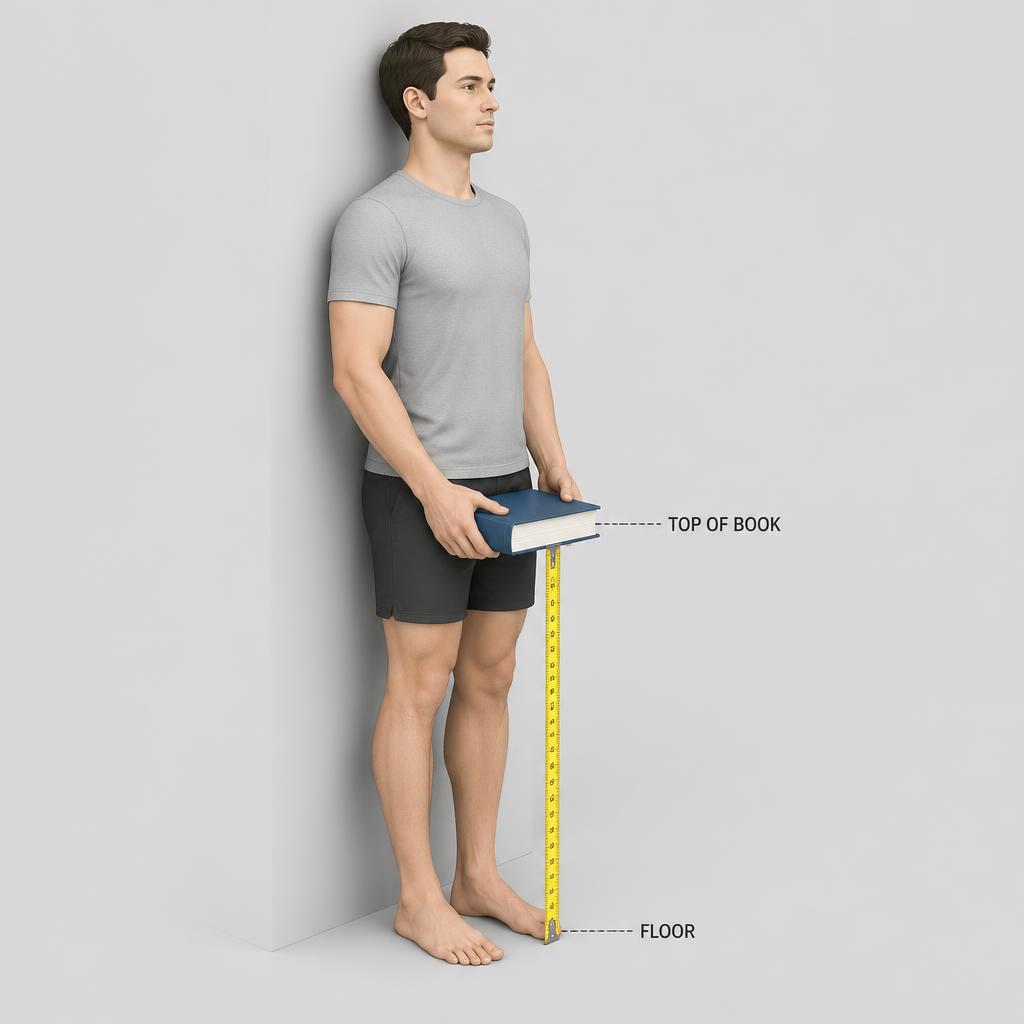
- Stand against a wall with bare feet about 6 inches (15 cm) apart.
- Place a hardcover book between your legs, spine upward, as if sitting on a bike saddle. Pull it firmly against your crotch.
- Have someone mark the wall at the top of the book while you stand straight.
- Measure from the floor to the mark in centimeters (or inches).
- Repeat twice and take the average for accuracy.
Quick formula: Road frame size (cm) ≈ Inseam (cm) × 0.67. For example, an 82‑cm inseam suggests a 55‑cm frame (±1 cm depending on brand).
Road Bike Size Chart – By Height & Inseam
Road bikes are traditionally sized by the seat tube length (center of bottom bracket to top of seat tube). However, modern compact geometry means top tube length and reach are equally important. Use this chart as a starting point:
| Rider Height | Inseam (cm) | Frame Size (cm) | Typical Label |
|---|---|---|---|
| 152–160 cm (5'0" – 5'3") | 66–71 cm | 47–49 cm | XXS – XS |
| 160–168 cm (5'3" – 5'6") | 71–76 cm | 49–51 cm | XS – S |
| 168–175 cm (5'6" – 5'9") | 76–81 cm | 51–53 cm | S – M |
| 175–183 cm (5'9" – 6'0") | 81–86 cm | 53–56 cm | M – L |
| 183–190 cm (6'0" – 6'3") | 86–91 cm | 56–59 cm | L – XL |
| 190–198 cm (6'3" – 6'6") | 91–96 cm | 59–62 cm | XL – XXL |
Road Bike Size Chart – Simplified by Height
| Rider Height | Frame Size (cm) | Common Label |
|---|---|---|
| 4'10" – 5'2" (147 – 157 cm) | 44 – 48 cm | XXS – XS |
| 5'2" – 5'6" (157 – 168 cm) | 48 – 52 cm | XS – S |
| 5'6" – 5'10" (168 – 178 cm) | 52 – 55 cm | S – M |
| 5'10" – 6'1" (178 – 185 cm) | 55 – 58 cm | M – L |
| 6'1" – 6'4" (185 – 193 cm) | 58 – 61 cm | L – XL |
Note: Different brands have slightly different geometry. Always check the manufacturer’s official geometry chart before purchase.
Stand‑Over Height – The Safety Check
Stand‑over height is the distance from the ground to the top tube at its midpoint. This is the quickest real‑world check for fit.
- How to check: Stand over the bike with both feet flat on the ground, wearing the shoes you plan to ride with.
- Road bike clearance: You should have 2–5 cm (1–2 inches) between your inseam and the top tube.
- Why it matters: Too little clearance risks injury during sudden stops. Too much clearance (more than 7–8 cm) often means the frame is too small for your leg length, though modern sloping top tubes are more forgiving.
If you are between sizes, stand‑over clearance becomes even more important: slightly more clearance is safer than too little.
Stack & Reach – Advanced Sizing for the Best Fit
Seat tube length alone does not tell the full story. Two frames marked as “54 cm” can feel completely different. That is where stack and reach come in.
- Stack – the vertical distance from the center of the bottom bracket to the top of the head tube. Higher stack means a more upright, comfortable position. Lower stack means a more aggressive, aerodynamic racing position.
- Reach – the horizontal distance from the center of the bottom bracket to the top of the head tube. Longer reach stretches your upper body forward (racer). Shorter reach gives a relaxed, endurance‑focused position.
How to use stack and reach: When comparing two frames, look for the ratio. A stack/reach ratio above 1.5 leans toward endurance comfort; below 1.5 leans toward race handling. If you have a current bike that fits well, you can use its stack and reach numbers to find a new frame that fits identically.
How to Fine‑Tune Your Road Bike Fit
Even with the correct frame size, small adjustments make a huge difference. Here are the most effective changes:
- Saddle height – With the pedal at the bottom of the stroke, your knee should have a slight bend (25–35 degrees). A simple formula: saddle height (cm) = inseam (cm) × 0.883, measured from center of bottom bracket to top of saddle along the seat tube.
- Saddle fore/aft – With cranks horizontal, a plumb line dropped from the front of your forward knee should intersect the pedal axle (KOPS – Knee Over Pedal Spindle).
- Stem length and angle – Use a shorter stem (70–90 mm) if the reach feels too long. Use a longer stem (110–130 mm) if you feel cramped. A positive angle stem raises the bars for comfort.
- Handlebar width – Bars should roughly match your shoulder width. Most adults ride 40–44 cm. A bar that is too wide compromises aerodynamics and can cause shoulder fatigue.
- Crank length – Most riders use 170–175 mm. Shorter cranks (165 mm) can benefit riders with shorter legs or those prone to knee pain.
Women‑Specific Sizing & Fit
Women often have longer legs relative to torso compared to men. Many brands offer women‑specific geometry with a shorter reach, taller stack, narrower handlebars, and women‑specific saddles. However, the same measurement process applies – inseam and stand‑over height remain the primary numbers. If you are between sizes, consider the smaller frame with a shorter stem for a better fit.
Frequently Asked Questions About Road Bike Sizing
What if I am between two sizes on the bike size guide road?
Can I use a mountain bike size chart for a road bike?
Does the frame material affect sizing?
Do I need a professional bike fit?
How do gravel bike sizes compare to road bikes?
Find Your Perfect Road Bike at Mondince Cycle
Now that you have followed this bike size guide road, you are ready to choose your next frameset. Mondince Cycle offers high‑quality carbon fiber road frames in sizes ranging from 47 cm to 62 cm, including popular models like the aero FM126, the all‑round FM106, and the endurance FM066. All frames feature T47 threaded bottom brackets, fully internal cable routing, and are tested at 130% of ISO 4210 standards.
👉 Explore Mondince carbon road bike frames
👉 Contact Mondince for custom geometry or OEM sizing support